NASA Scientific Discovery: Echo Mapping Unlocks Supermassive Black Hole Accretion Disks and Cosmic Distances
By examining reverberation delays between optical flashes and infrared light echoes, astrophysicists establish a new geometric ruler across active galactic nuclei.

Unraveling Echo Mapping: Turning Light Delays into Cosmic Rulers
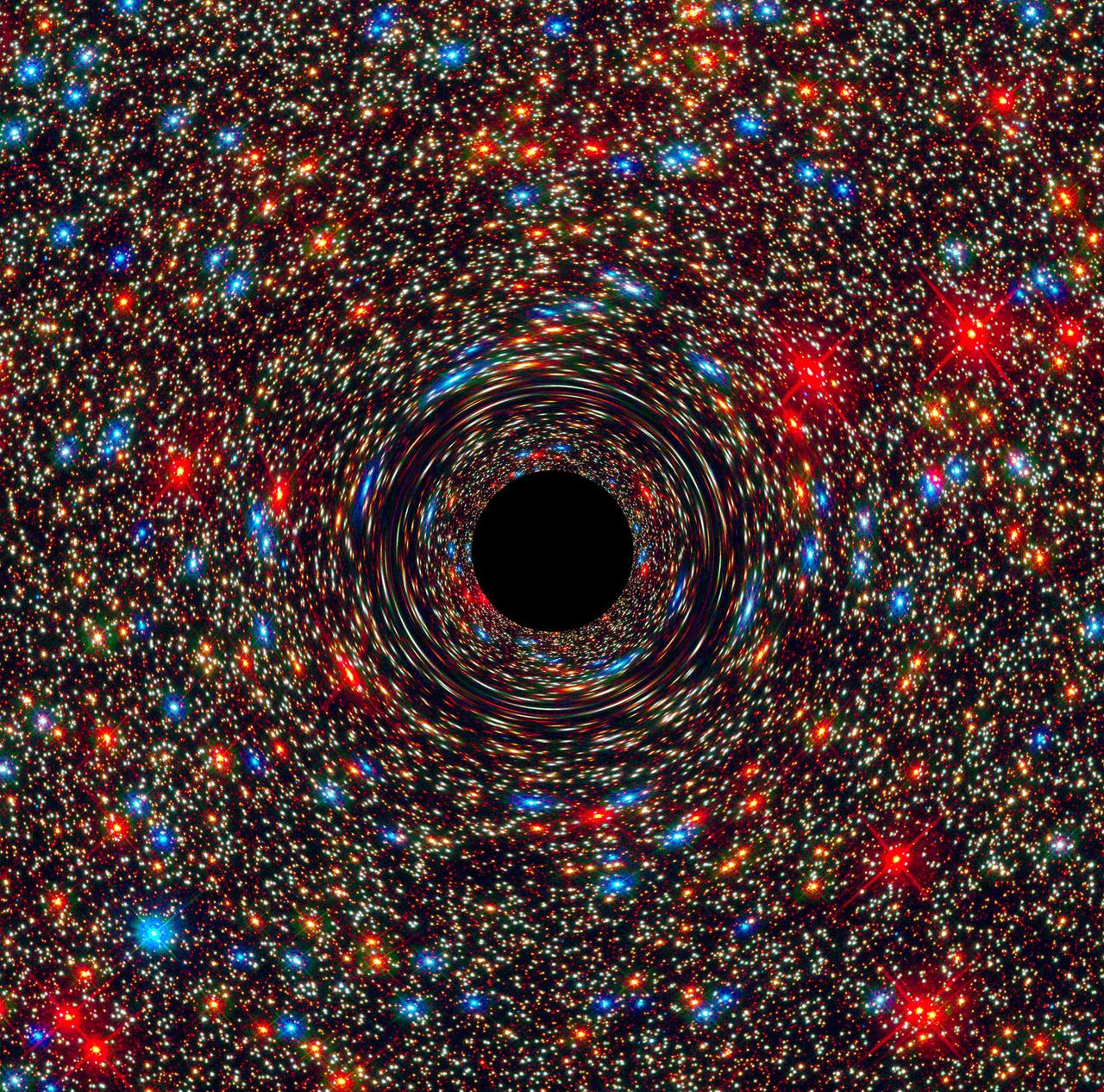
In the dense cores of active galaxies, supermassive black holes devour immense volumes of surrounding gas and dust. As this matter spirals inward, gravitational forces and extreme friction generate an extraordinary amount of heat, forming a bright accretion disk. Scientists have developed an astrophysics technique known as reverberation mapping—or "echo mapping"—to inspect these turbulent regions that remain far too distant for conventional direct imaging.
When short-lived, high-energy flares of visible light erupt from the inner accretion disk, the light radiates outward in all directions. A portion travels directly toward observers on Earth. However, another path leads to an outer doughnut-shaped structure made of dust particles, called a torus. When this visible radiation reaches the dust torus, it is absorbed, rapidly heating the dust grains until they glow in infrared wavelengths. Earth-based and space-borne instruments capture the initial visible flare first, followed months or years later by the infrared echo.
The Anatomy of an Active Galactic Nucleus: Disk to Torus
Understanding the architecture of an active galactic nucleus requires examining extreme thermal gradients. Near the event horizon, internal accretion disk temperatures easily reach tens of thousands of degrees. In this ultra-hot zone, any solid matter is instantly vaporized into ionized plasma.
As distance from the central engine increases, temperatures decrease. Dust grains can only survive and condense once the environment cools to approximately 2,200 degrees Fahrenheit (1,200 degrees Celsius). This fundamental thermodynamic boundary defines the inner edge of the doughnut-shaped dust torus.
| Structural Element | Temperature Profile | Primary Emission Wavelength | Scale / Physical Distance |
|---|---|---|---|
| Inner Accretion Disk | 10,000°F to >50,000°F | Ultraviolet & Visible Light | Sub-light-days from center |
| Dust Condensation Boundary | ~2,200°F (1,200°C) | Near-Infrared Threshold | Light-months from center |
| Outer Dust Torus | Hundreds of °F to 2,200°F | Mid-to-Far Infrared | Trillions of miles (Light-years) |
Light Travel Dynamics and the Physics of Distance Measurement
Light moves through the vacuum of space at approximately 186,000 miles per second (300,000 kilometers per second). Despite this velocity, crossing the expanse between a black hole's inner disk and the inner boundary of its dust torus can require months or even years of travel time.
This light delay provides astronomers with a powerful geometric tool. The more luminous an accretion disk is, the more heat it pours into the surrounding environment, forcing the dust condensation boundary further outward. Because brighter disks push the torus further away, the time delay between the optical flare and the infrared echo is longer in highly luminous systems.
By measuring the precise delay between the primary flash and the secondary infrared echo, scientists can calculate the physical size of the gap in miles or kilometers. Combining this physical scale with the disk's observed brightness from Earth allows researchers to calculate its intrinsic luminosity—effectively creating a standard cosmic candle for deep-space distance measurement.
Observations via NEOWISE Sky Surveys
To systematically test reverberation mapping, researchers turned to extensive data captured by NASA's Near-Earth Object Wide-field Infrared Survey Explorer (NEOWISE), formerly known as WISE. Conducting full-sky surveys approximately once every six months, NEOWISE amassed a multi-year baseline of infrared observations across the observable universe.
A comprehensive study utilizing NEOWISE data tracked the luminosity profiles of over 500 active galactic nuclei. By searching for correlated optical and infrared light echoes across multiple observational epochs, researchers demonstrated that reverberation mapping operates reliably on large galaxy samples. However, current distance estimates derived from echo mapping show broader margin ranges than established cosmic ladder methods, such as Type Ia supernovae or Cepheid variable calibration.
Improving Precision: Modeling Torus Dynamics and Future Telescopes
To turn reverberation mapping into a precision cosmological tool, astrophysicists are actively refining structural models of the dust torus. Real-world dust structures are rarely perfect uniform doughnuts; they exhibit clumpiness, complex orientation angles, and varying dust grain compositions that alter how light echoes are absorbed and re-emitted.
With expanded infrared monitoring capabilities from next-generation space observatories, scientists aim to constrain these structural variables. By combining high-resolution multi-wavelength light curves with enhanced dynamic models of torus interiors, future observational campaigns promise to turn black hole echoes into highly precise mapping beacons across cosmic time.
Frequently Asked Questions
Q: What is echo mapping in astrophysics?
A: Echo mapping, also known as reverberation mapping, is an astrophysics technique that measures the time lag between an initial visible light flash from an accretion disk near a black hole and its subsequent infrared echo re-radiated by a surrounding torus of dust.
Q: How does light from an accretion disk turn into infrared light?
A: Visible light flares travel outward across trillions of miles until striking dust in the torus. The dust absorbs the optical radiation, heats up, and re-emits the energy at longer infrared wavelengths.
Q: Why can cosmic dust only form at specific distances from a black hole?
A: Temperatures close to the central black hole reach tens of thousands of degrees, destroying solid matter. Dust can only condense where ambient temperatures drop below approximately 2,200 degrees Fahrenheit (1,200 degrees Celsius).
Q: What role did NASA's WISE / NEOWISE mission play in this study?
A: NEOWISE surveyed the entire sky every six months, giving astronomers repeated opportunities over many years to monitor more than 500 black hole accretion disks and detect infrared light echoes.
Q: Can echo mapping be used to measure distances to distant galaxies?
A: Yes. By calculating the physical distance from light lag timing and comparing intrinsic luminosity against observed brightness on Earth, scientists can estimate cosmic distances to host galaxies.
Verified Primary & Secondary References
- NASA / Jet Propulsion Laboratory (JPL-Caltech) Science Data Catalog - PIA23866 Telemetry Archives.
- NASA Open Science Data Network - Wide-field Infrared Survey Explorer (WISE / NEOWISE) Active Galactic Nuclei Mapping Project.
- Astrophysical Journal Research Publications on Active Galactic Nuclei Dust Torus Reverberation Dynamics.