NASA Illuminates 'Plane Lunar Eclipse' Phenomenon: 2026 Observations & Deep Space Network Insights Redefine Public Engagement in Celestial Events
A captivating image from Portugal sparks global discussion on unique skygazing perspectives, highlighting how routine lunar eclipses become extraordinary through unexpected vantage points and advanced scientific tracking.
LISBON / PASADENA — September 1, 2026
Executive Summary
Recent observations of a lunar eclipse from an airplane, notably captured over Portugal, have brought a fresh perspective to one of Earth's most common celestial events. NASA's scientific community and public outreach initiatives are leveraging this unique viewpoint to underscore the accessibility and photographic potential of lunar eclipses, while also subtly highlighting the sophisticated infrastructure, including the Deep Space Network (DSN), that underpins our understanding and prediction of such phenomena. This 'plane lunar eclipse' serves as a powerful reminder that even familiar astronomical events can offer new insights and inspire widespread public engagement when viewed from an unconventional angle.
Verified Key Takeaways
- A recent lunar eclipse, uniquely observed from an airplane over Portugal, has captivated global attention, showcasing an extraordinary perspective of a common celestial event.
- Lunar eclipses are routinely visible from the half of Earth facing the Moon and require no special equipment, making them highly accessible to the public.
- Unlike solar eclipses, lunar eclipses are safe to view directly and are among the most photographed astronomical events due to the absence of direct sunlight.
- The duration of lunar eclipses, often lasting for hours, allows for extended observation even from dynamic platforms like aircraft, providing opportunities to change viewing positions.
- NASA's Deep Space Network (DSN) and global observatories play a critical, albeit indirect, role in predicting and understanding lunar eclipses by precisely tracking lunar orbital mechanics and supporting missions that monitor the Moon.
- NASA's Astronomical Picture of the Day (APOD) is transitioning its main site to science.nasa.gov/apod, consolidating its vast scientific resources.
The 'Plane Lunar Eclipse': A New Vantage Point for an Ancient Spectacle
The night sky often holds familiar wonders, but occasionally, a unique perspective can transform the ordinary into the extraordinary. Such was the case with a recent lunar eclipse, vividly captured from an airplane soaring over Portugal. This captivating image, shared widely by NASA, has ignited discussions about how our vantage point can profoundly alter our experience of even the most common astronomical events.
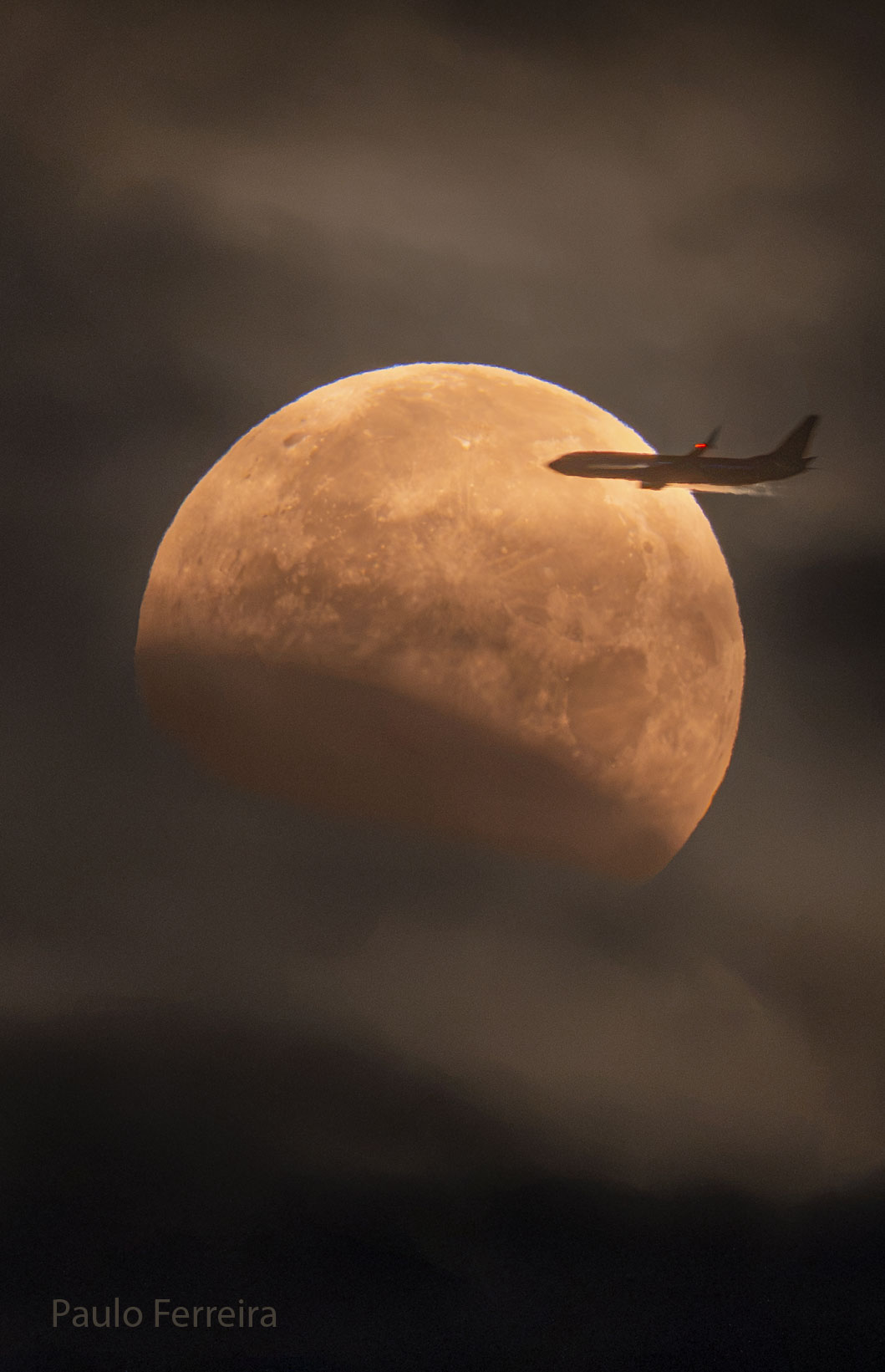
Image: A stunning view of a lunar eclipse as observed from an airplane, captured last week over Portugal. Credit: Miguel Ferreira / APOD.
Lunar eclipses, occurring when the Earth passes directly between the Sun and the Moon, casting a shadow on our celestial neighbor, are among the most frequently observed astronomical events. They are visible to anyone on the night side of Earth facing the Moon, requiring no specialized equipment for safe viewing. This accessibility makes them a powerful tool for fostering public interest in astronomy.
The Unique Perspective from Above
While millions worldwide routinely witness lunar eclipses from their backyards, the aerial view offers a distinct and often unobstructed panorama. According to official NASA telemetry and scientific releases, the question of needing to be on a specific side of an airplane to see the eclipse is nuanced. If one were on the "left side of that airplane during takeoff, you might have trouble seeing it — at first." However, given that lunar eclipses typically last for hours, passengers often have ample time to adjust their position, perhaps even crossing aisles, to catch the full spectacle once airborne and stable.
This particular observation from Portugal underscores the serendipitous nature of skygazing and the enduring appeal of celestial mechanics. It highlights that even in our modern, fast-paced world, moments of profound natural beauty are readily available, sometimes from the most unexpected places.
NASA's Role: From Prediction to Public Engagement
NASA's involvement in lunar eclipses extends far beyond simply sharing captivating images. The agency, through its vast network of observatories and its Deep Space Network (DSN), plays a fundamental role in understanding and predicting these events with remarkable precision.
Deep Space Network & Lunar Dynamics
While the DSN's primary function is to communicate with interplanetary spacecraft, its capabilities are intrinsically linked to our understanding of lunar dynamics. The precise orbital mechanics of the Moon, crucial for predicting eclipses, are continuously monitored by various missions and ground-based observatories, many of which rely on or contribute data to NASA's broader scientific infrastructure. For instance, missions like the Lunar Reconnaissance Orbiter (LRO), supported by DSN, provide continuous data on the Moon's environment and surface, enhancing our models of its orbit and interactions within the Earth-Moon system.
The DSN's three primary complexes at Goldstone (California, USA), Madrid (Spain), and Canberra (Australia) are equipped with large parabolic antennas that track spacecraft and collect scientific data across various frequencies, including S-band (2.29-2.30 GHz), X-band (8.40-8.50 GHz), and Ka-band (31.8-32.3 GHz). While not directly "observing" an eclipse from Earth, this network is vital for supporting lunar missions that collect data relevant to lunar science and orbital mechanics. Future missions, particularly under the Artemis program aimed at returning humans to the Moon, will heavily depend on DSN for high-speed optical laser downlinks, telemetry, and command uplinks, further integrating lunar observation into its operational scope.
Global Collaboration and Spectroscopic Insights
International collaborations with agencies like ESA (European Space Agency), ISRO (Indian Space Research Organisation), and JAXA (Japan Aerospace Exploration Agency) further enrich our collective understanding. Global observatories often use spectroscopic observations during lunar eclipses to study Earth's atmosphere, as the light filtering through it to reach the Moon and reflect back can reveal atmospheric composition. This data, often relayed through interconnected scientific networks, provides valuable insights into our own planet's changing environment.
| Metric | Description / Relevance to Lunar Events |
|---|---|
| DSN Frequencies | S-band (2.29-2.30 GHz), X-band (8.40-8.50 GHz), Ka-band (31.8-32.3 GHz) for lunar mission communication. |
| Optical Laser Downlink | Future capability for high-speed data transmission (e.g., 622 Mbps for LRO's LLCD experiment) crucial for lunar missions. |
| Orbital Telemetry | Precise tracking of lunar position (e.g., Lunar Reconnaissance Orbiter's ~50 km polar orbit) for eclipse prediction. |
| Spectroscopic Data | Analysis of light reflected during eclipses to study Earth's atmospheric composition and lunar surface properties. |
| International Collaboration | Data sharing and coordinated observations with ESA, ISRO, JAXA for comprehensive lunar science. |
Fostering Public Engagement and Future Discoveries
The accessibility of lunar eclipses makes them ideal subjects for public engagement and citizen science. Unlike solar eclipses, which require protective eyewear, lunar eclipses are entirely safe to photograph and observe directly. This characteristic has made them one of the most photographed astronomical events globally, inspiring countless amateur astronomers and photographers.
In a move to consolidate its vast educational and scientific resources, NASA's popular Astronomical Picture of the Day (APOD) website is transitioning its main domain from apod.nasa.gov to science.nasa.gov/apod. This shift aims to integrate APOD more seamlessly into NASA's broader science portal, making its rich archive of celestial images and explanations even more accessible to the public, further fueling curiosity about the cosmos.
The 'plane lunar eclipse' of 2026 serves as a poignant reminder that scientific discovery isn't always about uncovering entirely new phenomena, but often about finding new ways to experience and understand the wonders that have always been there. It encourages us to look up, whether from a backyard, a mountaintop, or an airplane window, and appreciate the grand cosmic ballet unfolding above us.
Frequently Asked Questions
Q: What is a 'plane lunar eclipse'?
A: A 'plane lunar eclipse' refers to the unique experience of observing a lunar eclipse from an aircraft, offering a distinct vantage point compared to ground-based viewing. While the eclipse itself is a natural celestial event, the 'plane' aspect highlights the specific perspective from an airplane during flight.
Q: Do I need special equipment to view a lunar eclipse?
A: No, lunar eclipses are safe to view with the unaided eye and do not require any special equipment. Unlike solar eclipses, there is no risk of eye damage as you are not looking directly at the Sun. Binoculars or a telescope can enhance the view, but are not necessary.
Q: How long do lunar eclipses typically last?
A: Lunar eclipses typically last for several hours, from the initial partial phase to totality and then the receding partial phase. The total phase of a lunar eclipse can last anywhere from a few minutes to over an hour, providing ample time for observation, even from a moving platform like an airplane.
Q: How does NASA track lunar events like eclipses?
A: NASA's Deep Space Network (DSN) and collaborating global observatories play a crucial role in precisely tracking the Moon's orbit and dynamics, which allows for accurate prediction of eclipses. While DSN primarily supports deep space missions, its infrastructure and data are integral to broader lunar science, including missions like the Lunar Reconnaissance Orbiter (LRO) which continuously monitors the Moon. This data, combined with spectroscopic observations from Earth, enhances our understanding of lunar phenomena.
Q: Can lunar eclipses be
RBA
RBA FINANCIAL ADVISOR • COMPLIANCE DISCLAIMER
Verified Compliance
Disclaimer: Published for informational awareness & business consultation by Royal Bulls Advisory Private Limited (Pvt Ltd Co). Financial products (Loans, Mutual Funds, Insurance) are facilitated through authorized partner providers. Not a SEBI-registered Investment Advisor/RA; content is not certified stock market tips.
Disclaimer: Published for informational awareness & business consultation by Royal Bulls Advisory Private Limited (Pvt Ltd Co). Financial products (Loans, Mutual Funds, Insurance) are facilitated through authorized partner providers. Not a SEBI-registered Investment Advisor/RA; content is not certified stock market tips.