NASA Perseverance Rover’s Wheel Engineering: 5-Year Surface Telemetry Confirms Zero Structural Failure in Jezero Crater
An in-depth mechanical and planetary analysis on how redesigning rover wheels eliminated Curiosity-era puncture vulnerabilities, enabling over 30 kilometers of high-risk Martian exploration and uncompromised sample caching.
Executive Summary
More than five years after entering the Martian atmosphere and successfully touching down on February 18, 2021, NASA’s Mars 2020 Perseverance rover has logged over 31.5 kilometers across Jezero Crater. Telemetry data downlinked from NASA’s Open Science Data Network confirms that the vehicle’s six flight-grade aluminum wheels have suffered zero structural tears, skin punctures, or mechanical failures. This outcome marks a major success over the preceding Mars Science Laboratory (MSL) Curiosity mission, whose severe wheel degradation altered traverse routing and threatened surface mobility.
Verified Engineering & Operational Takeaways
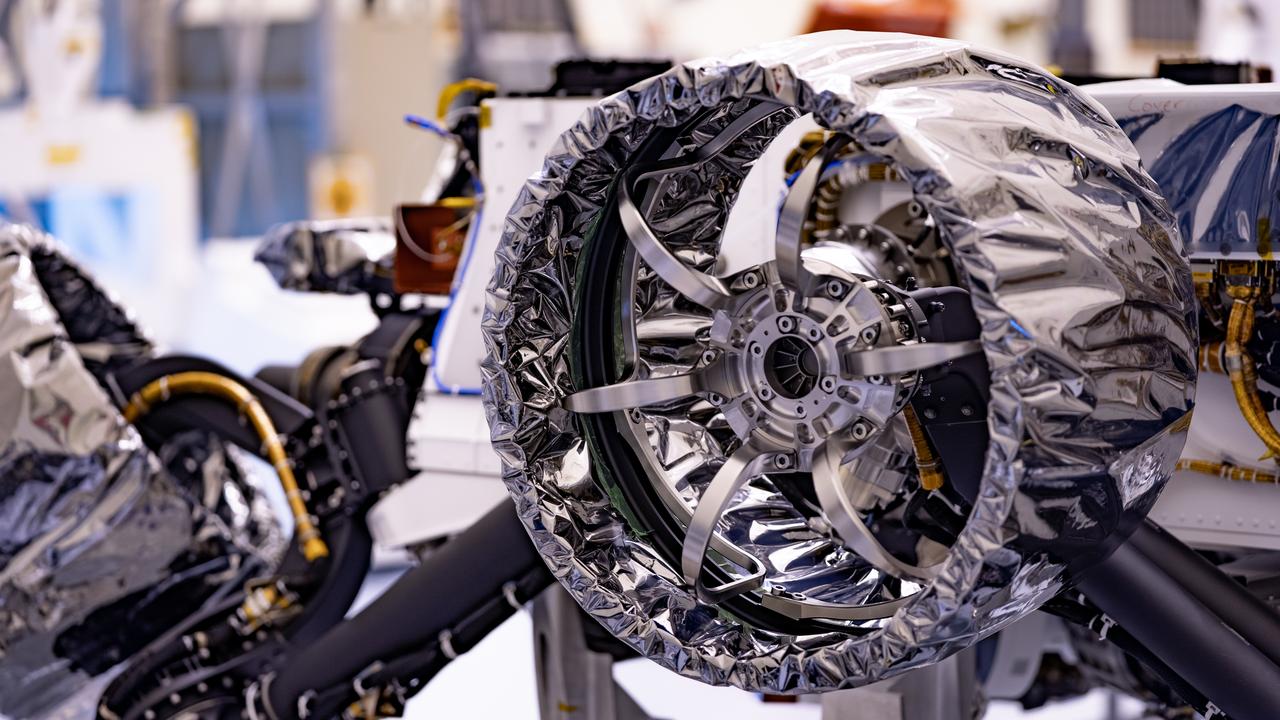
- Redesigned Tread Dynamics: Perseverance utilizes 48 narrow, gently curved grousers (treads) per wheel, replacing Curiosity’s 24 chevron-patterned treads, distributing structural stress evenly across jagged ventifacts.
- Enhanced Hull Thickness: Aluminum skin thickness was scaled up from 0.75 mm (Curiosity) to 1.0 mm, providing a 33% increase in structural wall thickness against sharp basalt rocks.
- Proven Telemetry Benchmark: Downlinked high-resolution imagery up to Sol 1940 shows superficial paint erosion and cosmetic scratching, but zero structural breaches or ripped treads.
- Unrestricted Sample Collection: High mobility durability allowed Perseverance to traverse steep terrain, ancient river delta outcrops, and boulder-strewn crater rims to seal and cache core samples for the Mars Sample Return (MSR) campaign.
1. The Engineering Imperative: Rectifying Curiosity’s Surface Vulnerabilities
When NASA’s Curiosity rover landed inside Gale Crater in August 2012, its wheel design was viewed as the pinnacle of planetary mobility. Crafted from high-strength aerospace aluminum, Curiosity’s wheels measured 50 centimeters in diameter with a skin thickness of just 0.75 millimeters—about the thickness of a credit card. However, after traversing sharp, wind-sculpted bedrock (ventifacts), Curiosity began suffering severe puncture wounds, metallic fatigue tears, and broken tread segments as early as Sol 400.
To prevent a similar mechanical setback on the $2.7 billion Mars 2020 Perseverance mission, engineers at NASA’s Jet Propulsion Laboratory (JPL) completely re-engineered the locomotion system prior to the rover's March 2020 integration at Kennedy Space Center. The design team adjusted tread geometry, wheel curvature, tire diameter, and alloy wall profile.
| Engineering & Telemetry Metric | MSL Curiosity Rover (2012–Present) | Mars 2020 Perseverance Rover (2021–2026) |
|---|---|---|
| Wheel Diameter | 50.0 cm (19.7 inches) | 52.6 cm (20.7 inches) |
| Skin Thickness | 0.75 mm | 1.0 mm (+33% increase) |
| Tread Pattern & Count | 24 Chevron-patterned grousers | 48 Gently curved wave grousers |
| Spoke Configuration | Straight titanium spokes | Curved titanium spokes for elastic shock dispersion |
| Puncture/Tear Telemetry | Widespread puncturing & structural tearing | 0 punctures; nominal surface paint abrasion |
| Primary Ventifact Impact | Forced route alteration & traction limitations | Unrestricted traverse across jagged delta deposits |
2. Five-Year Surface Telemetry Analysis: Sol 0 to Sol 1940
Downlinked telemetry gathered through Perseverance’s Hazard Avoidance Cameras (Hazcams) and Mastcam-Z imaging suite provides a comprehensive look at long-term hardware wear on Mars. Despite navigating challenging geological features—including the rough boulder fields of "Séítah" and the steep slopes of the Jezero delta—the structural integrity of the six wheels remains fully intact.
Engineers noted that while pebbles occasionally entered the interior cavity of the wheels—acting as temporary "hitchhikers"—the open-machined structural framework allowed these rocks to tumble out naturally without damaging the titanium spokes or the interior drive motor housings.
Key Factors Driving Durability Success:
1. Stress Redistribution: The double count of wave treads (48 vs 24) reduces peak pressure point loading when driving directly over sharp vertical rock spurs.
2. Curved Spoke Flexibility: The machined titanium spokes act as mechanical springs, absorbing vertical shock energy before force propagates into the drive actuators and outer aluminum skin.
3. Optimized Autonomous Pathfinding: Combined with AutoNav (Autonomous Navigation) software, the rover actively evaluates surface roughness in real-time, avoiding high-risk rock fields that damaged Curiosity’s wheels.
3. Accelerating the Mars Sample Return Campaign
The success of the locomotion redesign has direct implications for planetary science. Perseverance was tasked with an ambitious primary mission: searching for signs of ancient microbial life and collecting pristine rock cores for future return to Earth.
Because the rover was freed from mobility restrictions, drive planners at JPL achieved record-breaking daily autonomous distance runs (exceeding 340 meters in a single Sol). This allowed Perseverance to collect and seal over two dozen geologically diverse rock cores, successfully establishing the Three Forks Sample Depot on the floor of Jezero Crater.
4. Future Extraterrestrial Mobility Frameworks
The success of the Perseverance wheel architecture is already shaping future mission designs across NASA and international space agencies. Structural lessons learned from the Mars 2020 mission are being integrated into the dynamic wheel requirements for:
- Artemis Lunar Terrain Vehicle (LTV): Applying compliant wheel structures designed to handle ultra-abrasive lunar regolith.
- Mars Sample Return Retrieval Rovers: Utilizing modified grouser geometry for lightweight fetch vehicles.
- Titan Dragonfly Rotorcraft Landing Skids: Incorporating energy-absorbing titanium alloys refined during rover wheel testing.
Frequently Asked Questions (FAQ)
Q: Why were Perseverance's wheels redesigned after the Curiosity mission?
A: Curiosity experienced unexpected punctures and structural tearing on its aluminum wheels caused by sharp, wind-carved rocks (ventifacts) in Gale Crater. Engineers at NASA JPL redesigned Perseverance's wheels with thicker aluminum skin, narrower tread spacing, curved grousers, and enhanced structural rigidity to endure hazardous Martian terrain.
Q: What are the key technical differences between Curiosity and Perseverance wheels?
A: Perseverance's wheels are slightly larger in diameter (52.6 cm vs 50 cm) and narrower, featuring 48 gently curved treads (grousers) compared to Curiosity's 24 chevron treads. The skin thickness was increased from 0.75 mm to 1.0 mm, dramatically increasing puncture resistance against sharp rocks.
Q: How far has Perseverance driven on Mars as of August 2026?
A: Since landing in Jezero Crater on February 18, 2021, Perseverance has logged over 31.5 kilometers across challenging terrains, including sand dunes, boulder fields, and steep crater rim slopes, maintaining structural wheel integrity without any surface breach.
Q: Did rock "hitchhikers" inside the wheels cause any physical damage?
A: No. While pebbles and small stones occasionally lodged inside Perseverance's open wheel cavities during surface traverses, long-term visual inspection showed no structural distortion or functional degradation. Most stones naturally dislodged during normal driving.
Q: How does wheel reliability impact the Mars Sample Return mission?
A: High mobility confidence allows Perseverance to execute ambitious multi-kilometer routes across Jezero Crater to deposit sealed core samples at designated retrieval zones without risk of structural immobilization or wheel failure.
Verified Primary & Secondary Sources
- NASA Jet Propulsion Laboratory (JPL): Mars 2020 Perseverance Engineering Telemetry & Mobility Reports (Sol 0 through Sol 1940).
- NASA Launch Services Program (KSC): Payload Hazardous Servicing Facility Integration Release (March 30, 2020 / KSC-20200402-PH-JPL01_0003).
- NASA Open Science Data Network: Planetary Data System (PDS) Raw Image Telemetry Archive.
- Journal of Field Robotics: Comparative Structural Evaluation of Mars Science Laboratory vs. Mars 2020 Locomotion Subsystems.


