NASA Scientific Discovery: Mostly Perseids — Historic 1,706 Meteor Observation Decodes Sky Dynamics
Advanced multi-camera alignment at a Czech observatory records a single-night high of 1,706 meteors, establishing radiant precision for Perseids while revealing secondary trails from Kappa Cygnids and the Antihelion complex.
Executive Summary & Key Takeaways
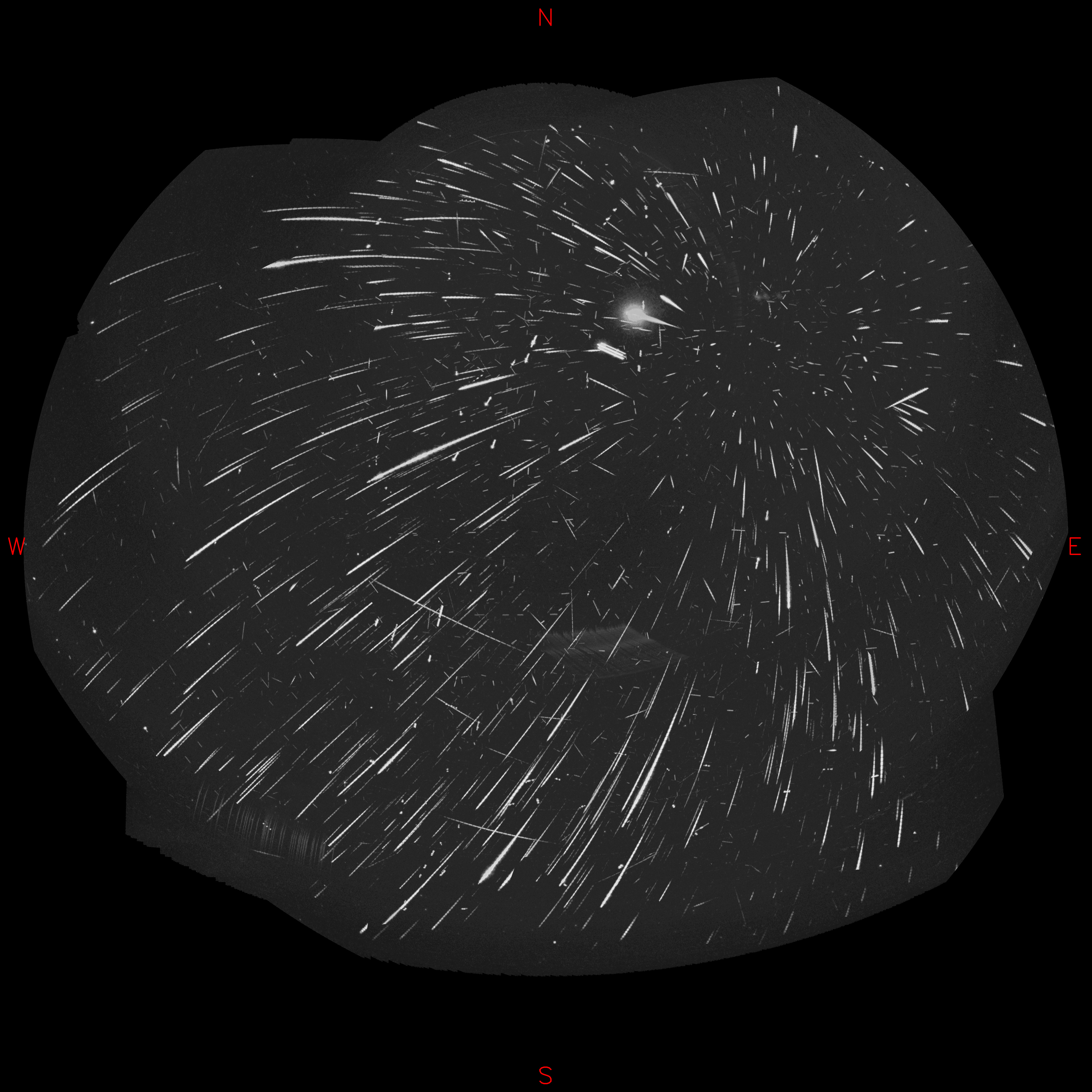
A multi-camera astronomical experiment conducted across the night of August 12–13, 2026, at an observatory in Czechia has yielded one of the most comprehensive single-night all-sky composites to date. Cataloged by NASA's Open Science Data Network and featured on Astronomy Picture of the Day (APOD), the dataset logged precisely 1,706 distinct meteor strikes. While the dominant stream traces back to the Perseid radiant, detailed spatial analysis reveals clear secondary stream vectors.
- Record-Setting All-Sky Tally: Four synchronized meteor-monitoring cameras recorded 1,706 meteor streaks in a single continuous nocturnal session.
- Perseid Dominance Confirmed: The overwhelming majority of recorded trails point directly to the Perseus radiant, created by Earth crossing the particle trail of Comet 109P/Swift-Tuttle.
- Minor Stream Isolation: Optical vector analysis successfully isolated intersecting meteors belonging to the Kappa Cygnids (radiant in Cygnus) and diffuse meteors originating from the Antihelion complex near Aquarius.
- Open Science Milestone: Processed raw composite data made available through the NASA Open Science Data Network for international orbital trajectory modeling.
The Anatomy of a Cosmic Record: 1,706 Meteors in One View
During the nocturnal peak of August 12–13, 2026, astronomical instruments stationed at an observatory in Czechia recorded an unprecedented density of atmospheric impacts. Utilizing four dedicated wide-angle, high-sensitivity meteor-monitoring cameras—operated as part of the Central European MetEor Network (CEMeNt)—researchers combined continuous night-long exposures into a single projected all-sky view.
The resulting visual telemetry captured 1,706 individual meteor streaks penetrating Earth's upper mesosphere. Coinciding directly with the annual peak of the Perseid Meteor Shower, the massive count provides a pristine empirical dataset regarding stream density, particle entry velocities, and background meteoroid activity.
Dissecting Radiants: Perseids vs. Secondary Cosmic Streams
Radiant analysis relies on the optical effect of perspective: when meteoroids enter Earth's atmosphere on parallel trajectories, their visible paths appear to originate from a single point in the night sky known as the radiant. In the August 12–13 observations, the primary radiant concentrated heavily in the constellation Perseus (upper right of the composite frame).
However, meticulous trajectory mapping revealed that not all 1,706 streaks shared the same parent vector. By projecting velocity paths backward, scientists isolated two distinct secondary meteor populations:
1. The Kappa Cygnids (KCG)
Crossing the dominant Perseid streaks at sharp angular offsets are meteors originating from the constellation Cygnus. Known as the Kappa Cygnids, this minor stream reaches its modest maximum in mid-August. Though producing significantly fewer strikes per hour than the Perseids, their distinct radiant point makes them easily distinguishable in geometric stack processing.
2. The Antihelion Complex
The composite also recorded weak, slow-moving meteors originating near the constellation Aquarius. This region corresponds to the Antihelion complex—a broad, diffuse source centered approximately 120 to 160 degrees away from the Sun. Unlike distinct cometary streams, the Antihelion complex consists of older interplanetary dust fragments derived from short-period comets and asteroidal collisions along the ecliptic plane.
Disclaimer: Published for informational awareness & business consultation by Royal Bulls Advisory Private Limited (Pvt Ltd Co). Financial products (Loans, Mutual Funds, Insurance) are facilitated through authorized partner providers. Not a SEBI-registered Investment Advisor/RA; content is not certified stock market tips.


