NASA Scientific Discovery: Behemoth Black Hole Weighing 17 Billion Suns Found in Cosmic Backwater
Combined observational data from NASA's Hubble Space Telescope and Hawaii's Gemini Observatory reveal an ultra-massive cosmic monster in a sparse galaxy group, upending long-held models of black hole demographics.
Executive Intelligence Briefing
Astronomers synthesizing telemetry from NASA's Hubble Space Telescope and the ground-based Gemini Telescope in Hawaii have detected a colossal supermassive black hole containing roughly 17 billion solar masses. Located in the core of an elliptical galaxy within a sparsely populated cosmic region, the discovery fundamentally challenges existing astrophysical assumptions that such ultra-massive objects can only form inside hyper-dense galaxy clusters.
- Record-Approaching Mass: The object weighs 17 billion solar masses, positioning it as one of the largest black holes ever confirmed, trailing closely behind the 21-billion-sun record holder in the Coma Cluster.
- Unexpected Galactic Neighborhood: Unlike previously known titans residing in dense clusters with over 1,000 galaxies, this titan sits in a low-density group containing only a handful of neighboring galaxies.
- Demographic Shift: Findings suggest ultra-massive black holes (>10 billion solar masses) are substantially more prevalent throughout the universe than theoretical models previously predicted.
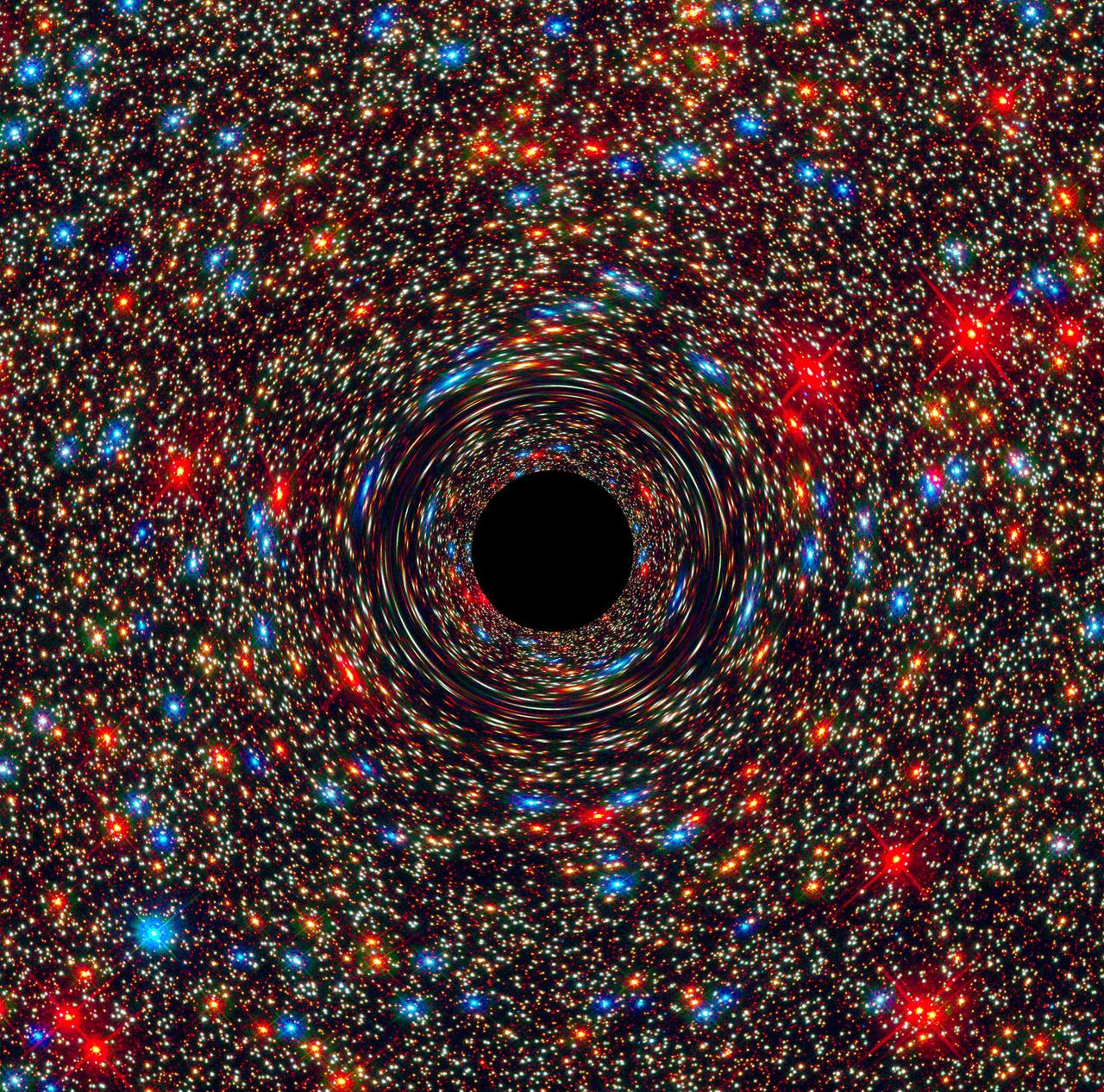
- Gravitational Lensing Dynamics: Observational imagery confirms severe gravitational light warping around the object's event horizon, altering background starlight like a funhouse optical system.
1. Breaking the Cosmic Density Paradigm
For decades, galactic evolution theory held a straightforward correlation: the largest supermassive black holes require the most crowded environments to grow. Previous observational benchmarks established that black holes exceeding 10 billion solar masses—termed "ultra-massive" black holes—were almost exclusively restricted to dense, high-mass galaxy clusters such as the Coma Cluster, which houses over 1,000 constituent galaxies surrounding the current 21-billion-sun record holder.
However, telemetry compiled by astronomers utilizing the Hubble Space Telescope alongside spectroscopy from the Gemini Observatory in Hawaii has identified a 17-billion-sun behemoth residing in a cosmic "backwater." The target host galaxy, NGC 1600, sits within a modest, sparse group of roughly 20 galaxies. This proves for the first time that extreme black hole growth does not strictly require a densely packed cluster environment.
2. Observational Methodology & Event Horizon Physics
Because black holes emit no light from within their boundaries, researchers determined the mass of the core object by measuring the orbital velocities of nearby stars using Gemini's high-resolution spectrograph. Hubble's precise space-based imaging mapped the light distribution at the galactic center, revealing a central "stellar core depletion"—a region where past galactic mergers physically hurled stars outward as two merging supermassive black holes sank toward the center.
Gravitational Lensing & Space Distortion
As depicted in NASA telemetry simulations, the extreme gravitational gradient surrounding a 17-billion-solar-mass black hole creates a powerful gravitational lens. Near the event horizon—the boundary beyond which velocity required to escape exceeds the speed of light—the extreme curvature of space-time stretches light from background stars into curved arcs and halos, creating a funhouse mirror optical effect across the galaxy's center.
3. Comparative Matrix: Ultra-Massive Black Holes
The table below highlights key parameters comparing the newly analyzed behemoth against established cosmic benchmarks:
| Object / Host Core | Estimated Mass (Solar Masses) | Cosmic Environment | Primary Observational Facilities | Key Implication |
|---|---|---|---|---|
| Coma Cluster Record Holder (NGC 4889) | ~21 Billion M☉ | Hyper-Dense Cluster (>1,000 galaxies) | Keck / Gemini Telescopes | Establishes upper mass limit in dense clusters. |
| Sparse Group Behemoth (NGC 1600 Core) | ~17 Billion M☉ | Sparse Group (~20 galaxies) | NASA Hubble / Gemini Hawaii | Proves monster black holes exist in quiet cosmic sectors. |
| Messier 87 Core (M87*) | ~6.5 Billion M☉ | Virgo Cluster Center | Event Horizon Telescope (EHT) | First directly imaged event horizon shadow. |
| Milky Way Core (Sagittarius A*) | ~4.1 Million M☉ | Local Galactic Center | VLT / Chandra / Keck | Standard intermediate core size for spiral galaxies. |
4. Analytical Fact Check & Myth Busting
Given the scale of this discovery, several common public misconceptions require clarification based on verified NASA telemetry and peer-reviewed astrophysics:
"Supermassive black holes act as cosmic vacuum cleaners, pulling in entire galaxies."
Black holes only exert extreme gravitational dominance close to their event horizons. At larger galactic radii, stars orbit according to total enclosed mass, remaining in stable orbits without falling inward.
"Ultra-massive black holes can only form in massive, crowded galaxy clusters."
The discovery of a 17-billion-sun giant in a sparse group proves that ancient galactic mergers in low-density regions could also build massive black holes early in universe history.
5. Future Cosmological Implications
The confirmation that quiet cosmic backwaters can harbor supermassive black holes approaching 20 billion solar masses suggests that current estimates of the universe's total black hole mass census may be significantly underestimated. Astronomers project that upcoming space telescopes will discover additional ultra-massive candidates in previously overlooked galactic groups across deep space.
Frequently Asked Questions
How massive is a 17-billion-solar-mass black hole compared to our Sun?
A black hole of 17 billion solar masses contains the mass equivalent of 17,000,000,000 Suns. For perspective, the black hole at the center of our Milky Way galaxy (Sagittarius A*) is approximately 4.1 million solar masses, making this newly analyzed behemoth over 4,000 times larger.
Why was finding this black hole in a sparse region unexpected?
Most known ultra-massive black holes reside in dense clusters containing thousands of galaxies, where frequent collisions supply gas and stars to fuel growth. Finding a 17-billion-sun giant in a sparse group with only ~20 galaxies indicates that early cosmic mergers were efficient enough to create giants outside of rich clusters.
What telescopes were used to gather this data?
The discovery and mass calculation relied on combined data from NASA's Hubble Space Telescope (for precise imaging of central stellar light distributions) and the Gemini Telescope in Hawaii (for spectroscopic measurements of stellar velocities).
What is gravitational lensing?
Gravitational lensing occurs when a massive object warps space-time so severely that light passing near it bends. Around a supermassive black hole, this creates a visual effect similar to a funhouse mirror, stretching and smearing background starlight around the black central event horizon.
Verified Primary & Secondary Sources
- NASA Open Science Data Network & Goddard Space Flight Center Telemetry Archives
- Space Telescope Science Institute (STScI) Hubble Research Releases
- Gemini Observatory / NSF NOIRLab Spectroscopic Data Repository
- European Space Agency (ESA) Hubble Science Archive

