NASA Scientific Discovery: Contemplating the Sun and Solar Dynamics
When human observers gather beneath the shadow of our star, astronomical mechanics transform into an awe-inspiring spectacle. Through new imagery and telemetry released via NASA's Open Science Data Network, we explore the physical dynamics of solar eclipses, sunspot formations, and the rare atmospheric phenomena accompanying celestial totality.
- 1. The Cosmic Canvas: Silhouettes at Glen Canyon
- 2. Solar Physics: Decoding Sunspots and Photospheric Features
- 3. The Path of Shadow: Global Eclipse Trajectories
- 4. Astronomical Convergence: Totality Meets the Perseid Meteors
- 5. NASA's Open Science Network and Heliophysics Research
- 6. Frequently Asked Questions
1. The Cosmic Canvas: Silhouettes at Glen Canyon
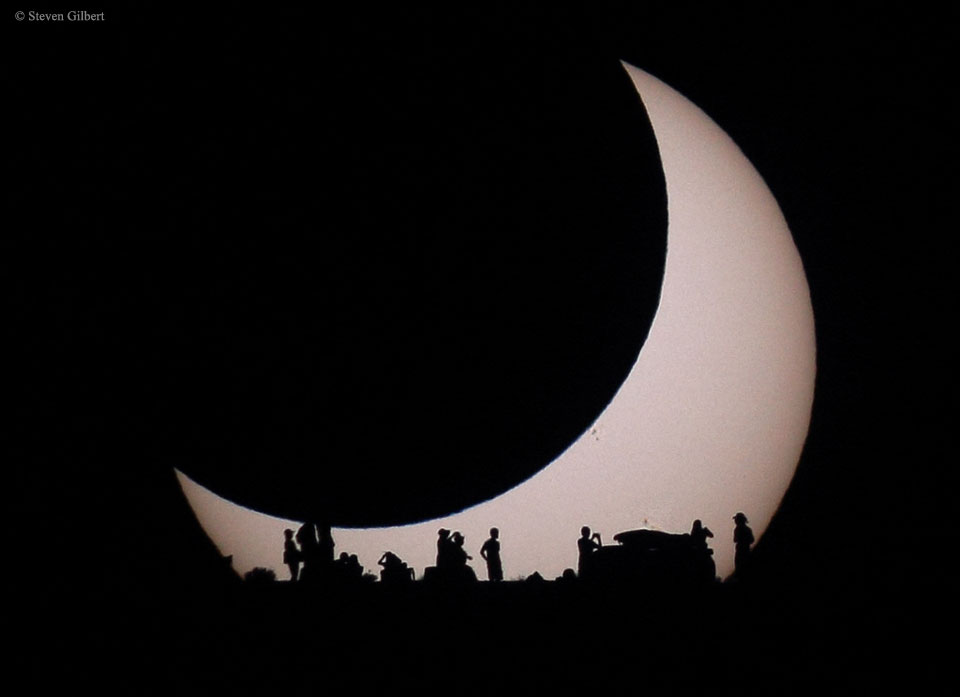
Few events in nature evoke the collective wonder of humanity quite like a solar eclipse. A newly featured image released through NASA's Astronomy Picture of the Day (APOD) archive encapsulates this rare intersection between human curiosity and orbital mechanics. Recorded from the elevated vantage points of Glen Canyon National Recreation Area near Page, Arizona, the photograph displays a composite silhouette of stargazers, park rangers, and astronomers gathered against the luminous disk of an eclipsed Sun.
During this partial and annular solar event, park interpreters and scientists utilized portable solar telescopes and optical projection screens to explain the physics of the solar disk to interested gatherers. The resulting silhouette illustrates how ground-based observation bridges the gap between complex astrophysics and public scientific engagement.
Key Insight: Solar eclipses provide unique scientific opportunities to study the Sun's lower atmosphere (chromosphere and corona) while fostering global public interest in planetary science and orbital mechanics.
2. Solar Physics: Decoding Sunspots and Photospheric Features
Beyond the dramatic silhouettes of the Moon and human observers, NASA telemetry revealed subtle features directly on the Sun's surface. Visible just to the lower right of the dark lunar perimeter in high-resolution captures is a prominent group of sunspots.
Sunspots represent regions of intense magnetic activity on the solar photosphere. In these localized areas, twisted magnetic field lines inhibit convection, preventing hot plasma from rising directly to the surface. Consequently, sunspots exhibit temperatures significantly cooler (approximately 3,000 to 4,500 Kelvin) than the surrounding solar surface (roughly 5,800 Kelvin), causing them to appear dark by contrast.
Tracking sunspot frequency allows heliophysicists to evaluate the solar cycle—an 11-year periodicity during which the Sun's magnetic poles reverse. During periods of solar maximum, intense sunspot active regions often spawn powerful solar flares and Coronal Mass Ejections (CMEs), sending high-energy charged particles across space to trigger geomagnetic storms and vivid auroras on Earth.
3. The Path of Shadow: Global Eclipse Trajectories
As celestial mechanics continuous their continuous cycle, another major solar eclipse pathway opens up across the Northern Hemisphere. The celestial geometry dictates that observers situated across northern North America, Western Europe, and northwestern Africa will witness varying degrees of a partial eclipse.
However, the central focus for research teams lies within the narrow "swath of totality"—a ground track extending all the way from the ice sheets of Greenland across the North Atlantic to the coastal landscapes of Portugal and Spain.
Understanding Eclipse Dynamics
A total solar eclipse occurs when the Moon passes directly between the Earth and the Sun, precisely matching the Sun's angular diameter as viewed from Earth. This remarkable cosmic coincidence is made possible because while the Sun is approximately 400 times larger than the Moon, it is also roughly 400 times farther away from Earth.
4. Astronomical Convergence: Totality Meets the Perseid Meteors
One of the most intriguing scientific questions surrounding upcoming total solar events taking place in mid-August involves the potential overlap with the annual Perseid meteor shower peak. The Perseids occur annually when Earth passes through the debris stream left behind by Comet 109P/Swift-Tuttle.
During total solar alignment, the sudden plunging of daytime skies into twilight darkness reveals bright stars, planets, and potentially bright meteor fireballs plunging through Earth's upper atmosphere.
Astronomical Query: Will bright Perseid fireballs be visible to ground observers and high-altitude airborne observatories during the brief minutes of solar totality? Atmospheric researchers and amateur skywatchers are actively preparing dedicated digital recording suites to document this rare dual phenomena.
5. NASA's Open Science Network and Heliophysics Research
Modern solar research relies heavily on continuous telemetry from specialized space missions, including the Solar Dynamics Observatory (SDO), the Parker Solar Probe, and joint ESA/NASA operations like Solar Orbiter. Through the NASA Open Science Data Network, these massive telemetry streams are made publicly available to global researchers, financial analysts evaluating space weather risks, and citizen scientists.
Space weather forecasting has become increasingly vital for modern technology infrastructure. High-energy solar storms can induce geomagnetic currents in power grids, disrupt satellite communications, skew GPS navigational accuracy, and expose high-altitude aviation routes to elevated radiation levels.
Frequently Asked Questions (FAQ)
What causes a solar eclipse to occur?
A solar eclipse occurs when the Moon passes directly between the Earth and the Sun, casting its shadow upon portions of the Earth's surface. Depending on alignment and orbital distance, the eclipse can be total, partial, or annular.
Why are sunspots visible on the solar disk during an eclipse?
Sunspots are intensely magnetic regions on the Sun's surface that are slightly cooler than the surrounding magnetic atmosphere. Because they radiate less light than the surrounding photosphere, they appear as dark spots when filtered through specialized solar optics or during partial eclipse conditions.
Is it safe to view a partial solar eclipse without special equipment?
No. Looking directly at the Sun without certified ISO 12312-2 solar viewing glasses or specialized telescope solar filters can cause severe, permanent retinal damage. Safe indirect viewing techniques include pinhole projection boxes and solar projection screens.
How does NASA's Open Science Data Network help solar research?
The network provides open access to petabytes of satellite telemetry and solar imaging datasets, enabling scientific institutions, climate modellers, and independent analysts worldwide to investigate space weather, solar flare dynamics, and long-term magnetic trends.
Conclusion & Practical Takeaways
Contemplating the Sun serves as a powerful reminder of Earth's position within a dynamic solar system. From human gatherings in Glen Canyon to spaceborne observatories tracking magnetic active regions, solar study combines human wonder with crucial technical advancement. As upcoming eclipse events span across Greenland, Europe, and North America, researchers stand ready to capture new insights into solar physics and cosmic interactions.


