NASA Scientific Discovery: 22-Year Astrophotography Composite Visualizes the Complete Projection of Earth's Shadow
From Aristotelian proofs to modern space geometry: How decades of precision astronomical telemetry compiled Earth's circular umbral projection, faint atmospheric blue bands, and upcoming lunar eclipse dynamics.
Executive Briefing & Key Takeaways
A multi-decade observational scientific endeavor curated by NASA's Open Science channels has synthesized 22 years of high-resolution lunar eclipse exposures into a unified visualization of Earth's geometric shadow cone. Demonstrating fundamental principles of celestial optics, planetary atmospheric scattering, and orbital mechanics, the synthesis provides unprecedented clarity on the structure of Earth's umbra.
- 22-Year Photographic Synthesis: High-precision digital astrophotography captures the complete circular extent of Earth's shadow, which cannot be viewed in its entirety during a single lunar eclipse.
- Atmospheric Blue Band Detection: Detailed pixel analysis reveals a faint blue fringe along the edge of the shadow, created as stratospheric ozone absorbs red light while permitting blue wavelengths to pass through.
- Orbital Mechanics & Inclination: The lunar orbit's 5.14-degree tilt relative to the ecliptic plane explains why eclipses occur only during specific alignment nodes rather than monthly.
- Upcoming Astronomical Observation: A new lunar eclipse is scheduled to take place later this week, with optimal visibility spanning North and South America, Europe, and Africa.
- Infrastructure Transition: NASA Astronomy Picture of the Day (APOD) is officially migrating its primary web infrastructure from apod.nasa.gov to science.nasa.gov/apod.
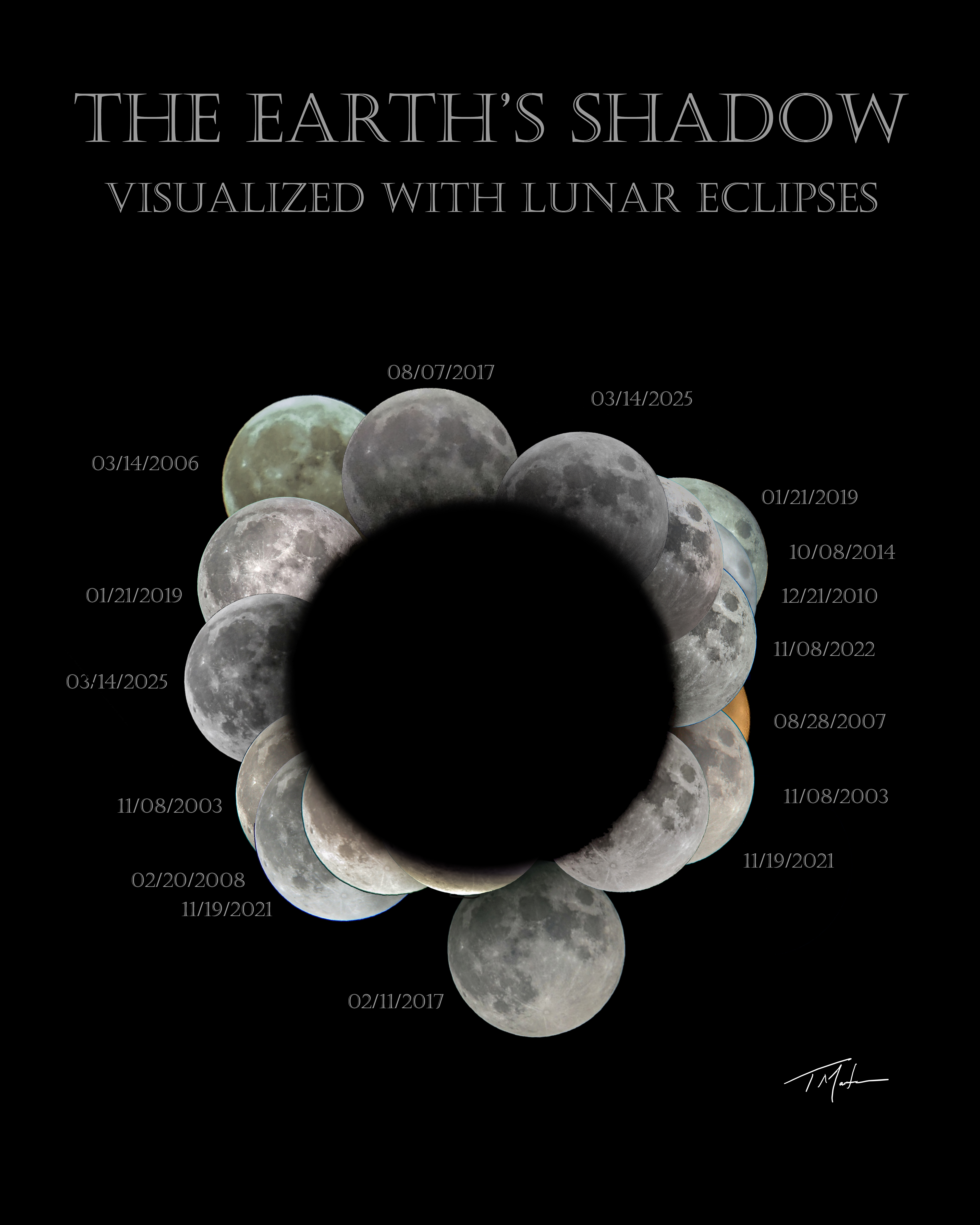
Mapping the Silhouette of Earth: A Decadal Astronomical Achievement
Looking up into the night sky during a lunar eclipse reveals one of humanity's oldest observational windows into planetary geometry. Since the era of Aristotle, natural philosophers noted that the shadow cast upon the Moon during a partial eclipse was unmistakably curved. However, because the Moon's angular diameter covers only a fraction of Earth's deep shadow cone at a distance of 384,400 kilometers, a single eclipse event presents only a small arc of the overall profile.
Now, through modern high-dynamic-range digital imaging and computational astrophotography, researchers and persistent observers have combined 22 years of lunar eclipse telemetry into a single definitive mosaic. Released through NASA's scientific evaluation network, the composite reveals the true circular boundary of Earth's umbral shadow projected directly onto space.
"What is creating this giant hole in space? This is not a black hole — it is a shadow. It is Earth's shadow... Using modern digital technology, the images of multiple lunar eclipses can be combined to show Earth's complete shadow."
Atmospheric Physics: Red Rays, Blue Bands, and Ozone Absorption
While Earth's shadow appears dark against the lunar surface, close inspection of high-resolution digital exposures reveals complex chromatic structure along the shadow boundary. Standard total lunar eclipses render the Moon in deep copper or brick-red tones — a phenomenon famously known as a "blood moon." This occurs because Earth's lower atmosphere scatters shorter blue wavelengths of sunlight (Rayleigh scattering) while refracting longer red wavelengths into the central umbral cone.
However, the 22-year photographic synthesis highlights a second, subtle optical effect: a distinct, faint blue band along the outer edge of the umbra. This blue fringe is caused by sunlight passing through Earth's upper stratosphere, where high concentrations of ozone selectively absorb red light while allowing blue light to pass through relatively unattenuated before striking the lunar rim.
| Parameters & Phenomena | Scientific Characteristics | Observational Impact on Lunar Surface |
|---|---|---|
| Umbral Core (Central Shadow) | Refracted sunlight filtered through troposphere | Deep red / copper color profile (Rayleigh scattering) |
| Ozone Blue Band (Penumbra Rim) | Light passing through upper stratospheric ozone layer | Faint turquoise / blue fringe at shadow interface |
| Lunar Orbit Inclination | 5.14 degrees relative to Earth's ecliptic plane | Prevents monthly eclipse occurrences during full moon phase |
| Composite Baseline Period | 22 Years of continuous digital astrophotography | Full circular reconstruction of Earth's space projection |
Celestial Mechanics: Why Eclipses Are Rare Occurrences
A common point of inquiry among skywatchers is why a lunar eclipse does not take place every month (or "moon-th"). If the Moon orbits Earth every 29.5 days relative to the Sun, one might expect the Moon to pass directly through Earth's shadow during every full moon phase.
The explanation lies in orbital geometry. The orbit of the Moon around Earth is tilted by approximately 5.14 degrees with respect to Earth's orbital plane around the Sun (the ecliptic). Most of the time, the full moon passes slightly above or below Earth's umbral shadow cone. A lunar eclipse can only occur when the full moon coincides with the Moon crossing the ecliptic plane at points known as orbital nodes.
Upcoming Lunar Eclipse Event and NASA System Migration
According to flight dynamics data and ephemeris calculations highlighted in the NASA telemetry release, an upcoming lunar eclipse will take place later this week. Stargazers and astronomers across North America, South America, Europe, and Africa will have an optimal viewing window, subject to local meteorological conditions.
Concurrently, NASA has announced an operational migration of its primary public science archive. The legacy hosting address for the Astronomy Picture of the Day (APOD) is officially transitioning from apod.nasa.gov to the consolidated portal at science.nasa.gov/apod, standardizing open science delivery under NASA's centralized web architecture.
सूत्रों और मीडिया रिपोर्टों के अनुसार, यह 22 साल का खगोलीय संकलन न केवल पृथ्वी की सटीक छाया को दर्शाता है, बल्कि अंतरिक्ष अनुसंधान में डिजिटल एस्ट्रोफोटोग्राफी के बढ़ते महत्व को भी साबित करता है। इस अभूतपूर्व वैज्ञानिक उपलब्धि और आगामी चंद्रग्रहण पर आपकी क्या राय है? कमेंट में जरूर बताएं!
Frequently Asked Questions
Q: Why is Earth's full shadow not visible during a single lunar eclipse?
A: The Moon's physical size is much smaller than the diameter of Earth's umbral shadow at the Moon's distance. Consequently, during a single eclipse, the Moon only traverses a portion of the shadow, displaying a curved arc. It requires digital alignment of multiple eclipses across different orbital configurations over years to map the complete circle.
Q: What causes the faint blue fringe visible along the edge of Earth's shadow?
A: The blue fringe is produced by sunlight passing through Earth's stratospheric ozone layer. Ozone strongly absorbs red wavelengths of light, allowing blue light to pass through and illuminate the transition zone between Earth's full penumbra and complete umbra.
Q: Why does a lunar eclipse not occur every month?
A: The Moon's orbit around Earth is tilted by roughly 5.14 degrees relative to Earth's orbit around the Sun. Because of this inclination, the full moon usually passes above or below Earth's shadow cone. Eclipses only happen when the Moon is near the intersection points (nodes) of these two orbital planes.
Q: Where can the upcoming lunar eclipse be viewed?
A: The upcoming lunar eclipse will be best visible across major regions of North and South America, Western Europe, and Africa, provided sky conditions are clear.
Q: What operational change is happening with NASA's APOD platform?
A: NASA is migrating the Astronomy Picture of the Day service from its legacy address apod.nasa.gov to its modern science portal domain science.nasa
Disclaimer: Published for informational awareness & business consultation by Royal Bulls Advisory Private Limited (Pvt Ltd Co). Financial products (Loans, Mutual Funds, Insurance) are facilitated through authorized partner providers. Not a SEBI-registered Investment Advisor/RA; content is not certified stock market tips.


No comments:
Post a Comment