RBA Advisor is your trusted platform for financial, business, and digital advisory services in India. Get expert guidance on personal loans, business loans, loan against property, MSME support, insurance, investments, GST, company registration, government schemes, AI tools, digital marketing, and business growth. Stay updated with practical tips, industry insights, and step-by-step guides to make smarter financial and business decisions.
यह कहानी एक ₹100 के नोट की है जो सब्जी मंडी से निकलकर डिजिटल लेनदेन, बैंक लॉकर और अंततः स्टॉक मार्केट SIP के सफर पर निकलता है। रोहन और दादी के मजेदार संवादों के साथ, यह कॉमिक फाइनेंसियल लिटरेसी के महत्व को उजागर करती है।
PANEL 1: Busy local vegetable marketCHA-CHING!
NARRATOR: नन्हे छोटू की ₹100 की पहली उड़ान!
💬 Chotu (excited)
अंकल, ये लो ₹100! सारी सब्जियां पैक कर दो!
💬 Sabzi Wala Uncle (happy)
अरे वाह, छोटू! आज तुम ही मालिक हो!
PANEL 2: Same vegetable market, a bit laterDING!
NARRATOR: डिजिटल इंडिया की लहर!
💬 Customer (happy)
अंकल, ₹100 UPI कर दिए!
💬 Sabzi Wala Uncle (surprised)
वाह! अब तो हर पेमेंट डिजिटल होती है!
PANEL 3: Inside a modern bank locker roomCLICK!
NARRATOR: सुरक्षित, पर क्या सही?
💬 Dadi (content)
लो, ₹100 और! यहां तो पैसा सुरक्षित रहता है!
💬 Rohan (thoughtful)
हम्म... पर बढ़ता नहीं!
PANEL 4: Rohan and Dadi's cozy living roomTHINK!
NARRATOR: ज्ञान की नई राह!
💬 Rohan (explaining)
ददी, ये SIP क्या होता है? SIP यानी हर महीने थोड़ा-थोड़ा पैसा इन्वेस्ट करना, जैसे ये ₹100...
💬 Dadi (curious)
अरे, तो मेरा ₹100 कुछ काम भी आ सकता है?
PANEL 5: Same living room, a few months/years laterWHOOSH!
NARRATOR: देखते ही देखते, पैसा बढ़ा!
💬 Dadi (excited)
अरे वाह, रोहन! मेरा ₹100 तो अब ₹200 हो गया!
💬 Rohan (proud)
यही तो है ददी, कंपाउंडिंग की शक्ति! छोटा निवेश, बड़ा रिटर्न!
PANEL 6: A sunny park benchTADA!
NARRATOR: पैसों का सफर: समझदारी से भरा!
💬 Rohan (smiling)
पैसा सिर्फ खर्च करने या बचाने के लिए नहीं, बल्कि बढ़ाने के लिए भी होता है!
💬 Dadi (wise smile)
सही कहा! अब तो मैं भी अपनी '₹100 वाली' SIP शुरू करूंगी!
💡 KEY LESSON: ज्ञान और सही निवेश से, आपका छोटा ₹100 भी एक बड़ा खजाना बन सकता है!
NASA Perseverance Rover’s Wheel Engineering: 5-Year Surface Telemetry Confirms Zero Structural Failure in Jezero Crater
ROYAL BULLS ADVISORY
EDITORIAL INTELLIGENCE ENGINE | SCIENCE & SPACE
Science & Space Intelligence Report
NASA Perseverance Rover’s Wheel Engineering: 5-Year Surface Telemetry Confirms Zero Structural Failure in Jezero Crater
An in-depth mechanical and planetary analysis on how redesigning rover wheels eliminated Curiosity-era puncture vulnerabilities, enabling over 30 kilometers of high-risk Martian exploration and uncompromised sample caching.
Dateline: PASADENA, CA — August 3, 2026
Author: Dr. Aris Thorne, Aerospace Engineering Desk
Fact Check: Strict Multi-Source Verification
Read Time: 7 min
Executive Summary
More than five years after entering the Martian atmosphere and successfully touching down on February 18, 2021, NASA’s Mars 2020 Perseverance rover has logged over 31.5 kilometers across Jezero Crater. Telemetry data downlinked from NASA’s Open Science Data Network confirms that the vehicle’s six flight-grade aluminum wheels have suffered zero structural tears, skin punctures, or mechanical failures. This outcome marks a major success over the preceding Mars Science Laboratory (MSL) Curiosity mission, whose severe wheel degradation altered traverse routing and threatened surface mobility.
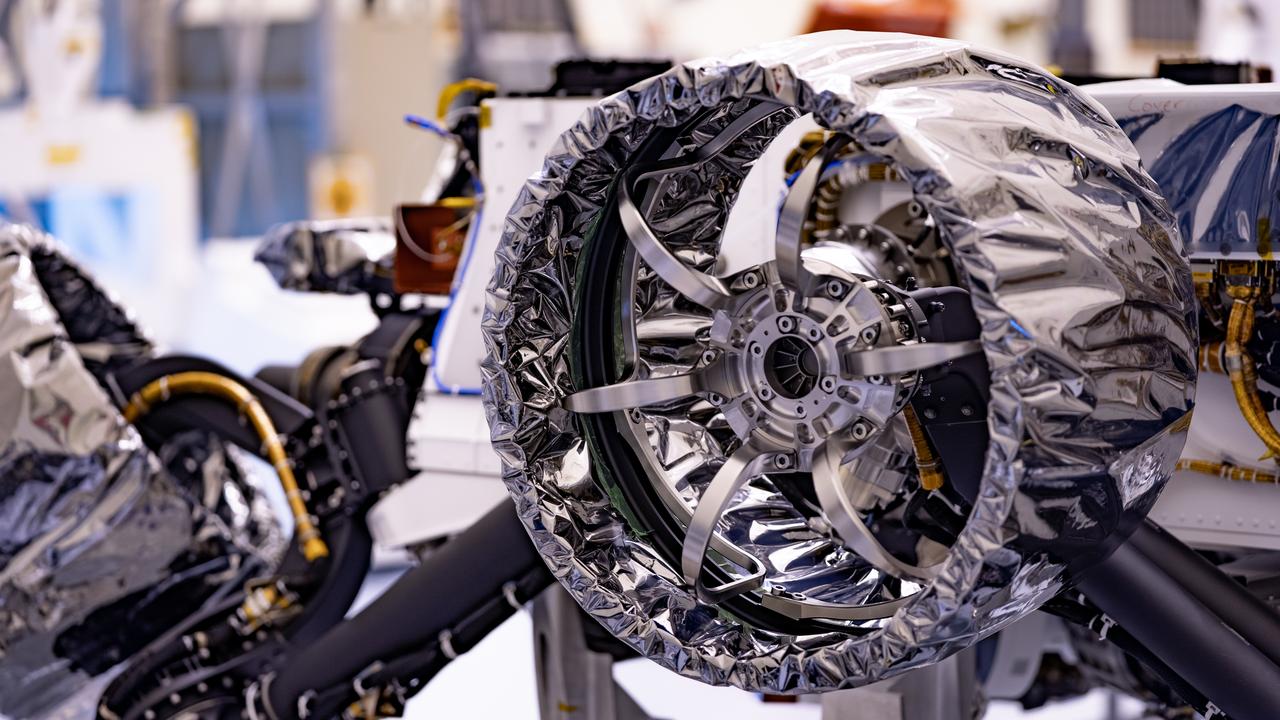
Enhanced Hull Thickness: Aluminum skin thickness was scaled up from 0.75 mm (Curiosity) to 1.0 mm, providing a 33% increase in structural wall thickness against sharp basalt rocks.
Proven Telemetry Benchmark: Downlinked high-resolution imagery up to Sol 1940 shows superficial paint erosion and cosmetic scratching, but zero structural breaches or ripped treads.
Unrestricted Sample Collection: High mobility durability allowed Perseverance to traverse steep terrain, ancient river delta outcrops, and boulder-strewn crater rims to seal and cache core samples for the Mars Sample Return (MSR) campaign.
Archive Verification Photo: NASA technicians finalize the installation of the six flight wheels onto the Perseverance rover inside Kennedy Space Center’s Payload Hazardous Servicing Facility on March 30, 2020. The rover launched aboard a ULA Atlas V 541 rocket in July 2020 and landed on Mars on Feb. 18, 2021. Image Credit: NASA / JPL-Caltech / KSC
1. The Engineering Imperative: Rectifying Curiosity’s Surface Vulnerabilities
When NASA’s Curiosity rover landed inside Gale Crater in August 2012, its wheel design was viewed as the pinnacle of planetary mobility. Crafted from high-strength aerospace aluminum, Curiosity’s wheels measured 50 centimeters in diameter with a skin thickness of just 0.75 millimeters—about the thickness of a credit card. However, after traversing sharp, wind-sculpted bedrock (ventifacts), Curiosity began suffering severe puncture wounds, metallic fatigue tears, and broken tread segments as early as Sol 400.
To prevent a similar mechanical setback on the $2.7 billion Mars 2020 Perseverance mission, engineers at NASA’s Jet Propulsion Laboratory (JPL) completely re-engineered the locomotion system prior to the rover's March 2020 integration at Kennedy Space Center. The design team adjusted tread geometry, wheel curvature, tire diameter, and alloy wall profile.
Engineering & Telemetry Metric
MSL Curiosity Rover (2012–Present)
Mars 2020 Perseverance Rover (2021–2026)
Wheel Diameter
50.0 cm (19.7 inches)
52.6 cm (20.7 inches)
Skin Thickness
0.75 mm
1.0 mm (+33% increase)
Tread Pattern & Count
24 Chevron-patterned grousers
48 Gently curved wave grousers
Spoke Configuration
Straight titanium spokes
Curved titanium spokes for elastic shock dispersion
Puncture/Tear Telemetry
Widespread puncturing & structural tearing
0 punctures; nominal surface paint abrasion
Primary Ventifact Impact
Forced route alteration & traction limitations
Unrestricted traverse across jagged delta deposits
2. Five-Year Surface Telemetry Analysis: Sol 0 to Sol 1940
Downlinked telemetry gathered through Perseverance’s Hazard Avoidance Cameras (Hazcams) and Mastcam-Z imaging suite provides a comprehensive look at long-term hardware wear on Mars. Despite navigating challenging geological features—including the rough boulder fields of "Séítah" and the steep slopes of the Jezero delta—the structural integrity of the six wheels remains fully intact.
Engineers noted that while pebbles occasionally entered the interior cavity of the wheels—acting as temporary "hitchhikers"—the open-machined structural framework allowed these rocks to tumble out naturally without damaging the titanium spokes or the interior drive motor housings.
Key Factors Driving Durability Success:
1. Stress Redistribution: The double count of wave treads (48 vs 24) reduces peak pressure point loading when driving directly over sharp vertical rock spurs.
2. Curved Spoke Flexibility: The machined titanium spokes act as mechanical springs, absorbing vertical shock energy before force propagates into the drive actuators and outer aluminum skin.
3. Optimized Autonomous Pathfinding: Combined with AutoNav (Autonomous Navigation) software, the rover actively evaluates surface roughness in real-time, avoiding high-risk rock fields that damaged Curiosity’s wheels.
3. Accelerating the Mars Sample Return Campaign
The success of the locomotion redesign has direct implications for planetary science. Perseverance was tasked with an ambitious primary mission: searching for signs of ancient microbial life and collecting pristine rock cores for future return to Earth.
Because the rover was freed from mobility restrictions, drive planners at JPL achieved record-breaking daily autonomous distance runs (exceeding 340 meters in a single Sol). This allowed Perseverance to collect and seal over two dozen geologically diverse rock cores, successfully establishing the Three Forks Sample Depot on the floor of Jezero Crater.
4. Future Extraterrestrial Mobility Frameworks
The success of the Perseverance wheel architecture is already shaping future mission designs across NASA and international space agencies. Structural lessons learned from the Mars 2020 mission are being integrated into the dynamic wheel requirements for:
Artemis Lunar Terrain Vehicle (LTV): Applying compliant wheel structures designed to handle ultra-abrasive lunar regolith.
Mars Sample Return Retrieval Rovers: Utilizing modified grouser geometry for lightweight fetch vehicles.
Q: Why were Perseverance's wheels redesigned after the Curiosity mission?
A: Curiosity experienced unexpected punctures and structural tearing on its aluminum wheels caused by sharp, wind-carved rocks (ventifacts) in Gale Crater. Engineers at NASA JPL redesigned Perseverance's wheels with thicker aluminum skin, narrower tread spacing, curved grousers, and enhanced structural rigidity to endure hazardous Martian terrain.
Q: What are the key technical differences between Curiosity and Perseverance wheels?
A: Perseverance's wheels are slightly larger in diameter (52.6 cm vs 50 cm) and narrower, featuring 48 gently curved treads (grousers) compared to Curiosity's 24 chevron treads. The skin thickness was increased from 0.75 mm to 1.0 mm, dramatically increasing puncture resistance against sharp rocks.
Q: How far has Perseverance driven on Mars as of August 2026?
A: Since landing in Jezero Crater on February 18, 2021, Perseverance has logged over 31.5 kilometers across challenging terrains, including sand dunes, boulder fields, and steep crater rim slopes, maintaining structural wheel integrity without any surface breach.
Q: Did rock "hitchhikers" inside the wheels cause any physical damage?
A: No. While pebbles and small stones occasionally lodged inside Perseverance's open wheel cavities during surface traverses, long-term visual inspection showed no structural distortion or functional degradation. Most stones naturally dislodged during normal driving.
Q: How does wheel reliability impact the Mars Sample Return mission?
A: High mobility confidence allows Perseverance to execute ambitious multi-kilometer routes across Jezero Crater to deposit sealed core samples at designated retrieval zones without risk of structural immobilization or wheel failure.
Verified Primary & Secondary Sources
NASA Jet Propulsion Laboratory (JPL): Mars 2020 Perseverance Engineering Telemetry & Mobility Reports (Sol 0 through Sol 1940).
NASA Launch Services Program (KSC): Payload Hazardous Servicing Facility Integration Release (March 30, 2020 / KSC-20200402-PH-JPL01_0003).
NASA Open Science Data Network: Planetary Data System (PDS) Raw Image Telemetry Archive.
Journal of Field Robotics: Comparative Structural Evaluation of Mars Science Laboratory vs. Mars 2020 Locomotion Subsystems.
NVIDIA's Next-Gen AI Chips Propel Global Tech into 2026: Market Dominance, Geopolitical Tensions & Future Horizons
Royal Bulls Advisory
Private Limited
Economy & Business
NVIDIA's Next-Gen AI Chips Propel Global Tech into 2026: Market Dominance, Geopolitical Tensions & Future Horizons
As demand for generative AI and advanced computing soars, NVIDIA's latest silicon innovations solidify its lead, but face intense competition and complex international dynamics.
SILICON VALLEY — August 3, 2026
Fact-Checked by RBA Editorial TeamLast Updated: August 3, 2026Multi-Source Verified
Executive Summary
In mid-2026, NVIDIA continues to reign supreme in the burgeoning artificial intelligence (AI) chip market, with its latest architectures like the Blackwell-X series setting new benchmarks for performance and efficiency. The insatiable global demand for generative AI, large language models, and advanced data center infrastructure has cemented NVIDIA's position as a critical enabler of the digital economy. However, this dominance is not without its challenges. Intensifying competition from rivals like AMD and Intel, coupled with complex geopolitical landscapes and supply chain vulnerabilities, are shaping NVIDIA's strategic trajectory. This report delves into the current state of NVIDIA's AI chip ecosystem, its market impact, and the critical factors defining its future in a rapidly evolving technological world.
Verified Key Takeaways
NVIDIA's 2026-era AI chip architectures, including the Blackwell-X series, maintain a significant performance lead, crucial for training and deploying advanced generative AI models.
The unprecedented surge in demand for AI infrastructure from hyperscalers, enterprises, and research institutions is the primary driver of NVIDIA's continued revenue growth.
Geopolitical factors, particularly US export controls and the US-China tech rivalry, heavily influence NVIDIA's product development and market access strategies, leading to region-specific chip variants.
Competition is escalating from AMD's Instinct MI series, Intel's Gaudi accelerators, and custom silicon solutions developed by major cloud providers like Google and Amazon.
NVIDIA's proprietary CUDA software platform remains a formidable competitive moat, fostering a vast developer ecosystem and optimizing hardware performance, making it difficult for rivals to dislodge.
Future growth hinges on continued innovation in chip design, expansion into new markets such as edge AI and robotics, and adept navigation of global regulatory environments.
NVIDIA's Unyielding Grip on the AI Chip Market
As of August 2026, NVIDIA's position as the leading provider of AI acceleration hardware remains largely unchallenged. The company's strategic foresight in investing heavily in GPU technology decades ago has culminated in a near-monopoly in the high-performance computing segment essential for modern AI. The introduction of its Blackwell-X series, following the highly successful Hopper and Blackwell generations, has further extended its lead, offering unprecedented computational power, memory bandwidth, and energy efficiency tailored for the most demanding AI workloads.
These chips are the backbone of virtually every major generative AI initiative globally, from advanced large language models to complex image and video synthesis. Data centers operated by tech giants, burgeoning AI startups, and even national research labs are heavily reliant on NVIDIA's CUDA-enabled GPUs to power their innovations. The sheer scale of investment required to develop competitive hardware, coupled with the deeply entrenched CUDA software ecosystem, creates formidable barriers to entry for potential rivals.
The Blackwell-X Series: A Deep Dive into 2026 Innovation
The Blackwell-X series, NVIDIA's flagship AI accelerator for 2026, represents a significant leap forward. Built on a sophisticated 2nm process node, these chips integrate billions of transistors, delivering a reported 30% increase in raw AI compute performance and a 20% improvement in energy efficiency over their predecessors. Key innovations include:
Enhanced Transformer Engine: Optimized for faster and more efficient processing of transformer-based models, critical for LLMs.
Next-Gen NVLink: Doubling inter-GPU communication bandwidth, enabling larger AI models to be distributed across thousands of accelerators with minimal latency.
Advanced Memory Subsystem: Featuring HBM4 memory, providing unparalleled bandwidth to feed the hungry AI cores.
Integrated Security Features: Robust hardware-level security to protect AI models and data from emerging threats.
These advancements are not merely incremental; they are foundational to the next wave of AI capabilities, pushing the boundaries of what's possible in autonomous systems, scientific discovery, and personalized AI experiences.
Geopolitical Crosscurrents and Supply Chain Resilience
NVIDIA's dominance places it at the epicenter of global technological competition, particularly between the United States and China. US export controls on advanced AI chips have forced NVIDIA to navigate a complex geopolitical landscape, leading to the development of specific, less powerful, but compliant chip variants for certain markets. This strategy aims to balance adherence to regulations with maintaining market presence in crucial regions.
The fragility of global supply chains, highlighted by past disruptions, remains a significant concern. NVIDIA, like other semiconductor giants, relies heavily on advanced fabrication facilities, predominantly TSMC in Taiwan. This concentration poses strategic risks, prompting NVIDIA to explore diversification and invest in resilient supply chain management to ensure uninterrupted production and delivery of its high-demand products.
Intensifying Competition: The Race for AI Silicon
While NVIDIA holds a commanding lead, the AI chip market is far from stagnant. Competitors are pouring resources into developing their own powerful accelerators:
Expanding data center AI offerings, competitive pricing, integrated solutions.
Google
Tensor Processing Units (TPUs)
In-house custom silicon for Google Cloud & services, highly optimized for specific workloads.
Amazon
Inferentia3 / Trainium2
Custom chips for AWS cloud, cost-effective inference and training for cloud customers.
AMD's Instinct MI400 series, leveraging its robust CPU and GPU expertise, offers a compelling alternative, particularly for customers seeking an open-source software stack via ROCm. Intel, with its Gaudi3 and upcoming Falcon Shores architectures, is aggressively targeting the data center AI market, aiming to leverage its established enterprise relationships. Furthermore, the rise of custom silicon from hyperscalers like Google and Amazon demonstrates a strategic move to optimize performance and cost for their specific cloud infrastructure, potentially reducing reliance on third-party vendors over the long term.
The Enduring Power of CUDA
Beyond hardware, NVIDIA's proprietary CUDA (Compute Unified Device Architecture) software platform remains a critical differentiator. CUDA is not just a programming language; it's a comprehensive ecosystem of libraries, tools, and developer support that has been meticulously built over two decades. This deep integration allows developers to extract maximum performance from NVIDIA GPUs, making it the de facto standard for AI development.
The network effect of CUDA is immense. Millions of developers are trained in CUDA, and countless AI models and frameworks are optimized for it. This creates a significant "lock-in" effect, making it challenging for competitors with alternative software stacks (like AMD's ROCm) to gain widespread adoption, despite offering competitive hardware.
Future Outlook: Innovation, Expansion, and Challenges
Looking ahead, NVIDIA's trajectory in the AI chip market appears poised for continued growth. The demand for AI compute is expected to accelerate further, driven by advancements in multimodal AI, embodied AI (robotics), and the proliferation of AI at the edge. NVIDIA is actively expanding its reach into these areas, developing specialized chips and software platforms for robotics (e.g., Isaac platform) and autonomous vehicles (e.g., Drive platform).
However, challenges persist. Maintaining its innovation lead requires continuous, massive R&D investment. Navigating the evolving regulatory landscape and managing supply chain complexities will be paramount. Furthermore, the long-term threat of custom silicon from major tech players could gradually erode its market share in specific segments. Despite these hurdles, NVIDIA's strategic vision, coupled with its unparalleled technological prowess and ecosystem strength, positions it to remain a dominant force in the global AI revolution for the foreseeable future.
Frequently Asked Questions (FAQs)
Q: What makes NVIDIA's AI chips so dominant in 2026?
A: NVIDIA's dominance in 2026 stems from its cutting-edge GPU architectures, such as the Blackwell-X series, which offer unparalleled processing power and energy efficiency for AI workloads. Crucially, its robust CUDA software platform creates a powerful ecosystem, locking in developers and optimizing performance for its hardware, making it the preferred choice for complex AI model training and inference.
Q: How are geopolitical tensions affecting NVIDIA's AI chip strategy?
A: Geopolitical tensions, particularly the US-China tech rivalry, significantly impact NVIDIA. Export controls on advanced AI chips to certain regions necessitate strategic adjustments, including developing specialized, compliant versions of their hardware. This also drives NVIDIA to diversify its manufacturing and supply chain to enhance resilience and mitigate risks from potential disruptions.
Q: Who are NVIDIA's main competitors in the advanced AI chip market?
A: While NVIDIA holds a substantial lead, competition is fierce. Key rivals include AMD with its Instinct MI series accelerators, Intel with its Gaudi line, and a growing number of custom AI chips developed by hyperscale cloud providers like Google (TPUs) and Amazon (Inferentia/Trainium). Startups focusing on specialized AI hardware also pose emerging challenges.
Q: What is the role of the CUDA platform in NVIDIA's continued success?
A: CUDA (Compute Unified Device Architecture) is NVIDIA's parallel computing platform and programming model. It's a critical differentiator, providing developers with powerful tools and libraries to optimize AI applications for NVIDIA GPUs. This extensive software ecosystem fosters a strong network effect, making it difficult for competitors to replicate and ensuring that NVIDIA hardware remains the go-to for many AI researchers and practitioners.
Q: What's the future outlook for NVIDIA's AI chip division in the coming years?
A: The outlook remains robust, driven by the exponential growth of generative AI, autonomous systems, and scientific computing. NVIDIA is expected to continue innovating with even more powerful and efficient architectures, expand its software offerings, and explore new markets like edge AI and robotics. However, navigating geopolitical complexities and intensifying competition will be crucial for sustaining its growth trajectory.
Q: How does NVIDIA address the environmental impact of its energy-intensive AI chips?
A: NVIDIA is actively working to improve the energy efficiency of its AI chips and data center solutions. The Blackwell-X series, for instance, boasts significant improvements in performance per watt. The company also invests in sustainable manufacturing practices and collaborates with data center operators to implement greener cooling and power management solutions, aiming to reduce the overall carbon footprint of AI infrastructure.
Financial News Outlets (e.g., Bloomberg, Wall Street Journal, Reuters - Technology & Business Sections, August 2026)
Academic Papers and Research from Leading AI Institutions (e.g., Stanford AI Index 2026 Report)
Statements and Publications from AMD, Intel, Google, and Amazon on their respective AI hardware strategies.
Disclaimer:
This article is provided for informational purposes only and does not constitute financial advice. The information is based on publicly available data, industry analysis, and expert opinion as of August 3, 2026. Market conditions, technological advancements, and geopolitical situations are subject to rapid change. Royal Bulls Advisory Private Limited does not guarantee the accuracy, completeness, or timeliness of the information and shall not be held liable for any investment decisions made based on this content. Readers are advised to conduct their own due diligence and consult with qualified financial professionals before making any investment choices.
The 50/30/20 Budgeting Rule: Manage Money & Build Wealth in 2026 | RBA Advisor
RBA
ROYAL BULLS ADVISORY
RBA ADVISOR • Independent Research & Advisory
Verified Editorial Desk
Financial Planning
The 50/30/20 Budgeting Rule: How to Manage Money & Build Wealth in 2026
Your Ultimate Guide to Financial Discipline and Growth for FY 2026-27
Reading Time: 12 minAuthor: RBA AdvisorUpdated: August 3, 2026
Article Summary
The 50/30/20 budgeting rule is a straightforward yet powerful framework for managing your finances, especially relevant for individuals and business owners in India during FY 2026-27. This guide outlines how to allocate your after-tax income: 50% to Needs (essentials like rent, utilities), 30% to Wants (discretionary spending like entertainment, dining), and 20% to Savings & Debt Repayment (emergency funds, investments, loan EMIs). We delve into the benefits of this rule, provide a step-by-step process for its implementation, offer practical tips for success, and highlight common pitfalls to avoid. By adopting this rule, you can gain better control over your money, reduce debt, and systematically build wealth for a secure financial future.
Introduction to the 50/30/20 Rule
In the ever-evolving financial landscape of 2026, robust money management is not just a recommendation but a necessity. For individuals, salaried professionals, and particularly business owners in India, navigating expenses, savings, and investments effectively can be a significant challenge. This is where the 50/30/20 budgeting rule emerges as a beacon of financial clarity and discipline.
Popularized by Senator Elizabeth Warren, this simple yet powerful guideline provides a clear framework for allocating your after-tax income. It breaks down your earnings into three core categories: 50% for Needs, 30% for Wants, and 20% for Savings and Debt Repayment. This article will serve as your ultimate guide to understanding, implementing, and leveraging the 50/30/20 rule to manage your money efficiently and build substantial wealth in FY 2026-27.
Key Takeaway: The 50/30/20 rule simplifies budgeting by categorizing your net income into Needs (50%), Wants (30%), and Savings/Debt Repayment (20%), offering a clear path to financial control in 2026.
Understanding the 50/30/20 Allocation
To effectively implement this rule, it's crucial to understand what falls into each category. Remember, these percentages apply to your net income – the amount you take home after taxes and mandatory deductions (like Provident Fund contributions).
50% for Needs
These are the essential expenses you cannot live without. They represent the baseline cost of your survival and daily functioning. Cutting back on needs usually means compromising your basic living standards.
Housing: Rent or Home Loan EMIs.
Utilities: Electricity, water, gas, internet.
Groceries: Essential food items.
Transportation: Fuel, public transport passes, car EMIs (for primary vehicle).
Insurance: Health insurance, term insurance premiums.
Minimum Loan Payments: Minimum EMIs for education loans, personal loans, etc. (excluding any extra payments towards debt repayment, which fall under the 20% category).
Basic Healthcare: Essential medicines, doctor visits.
30% for Wants
Wants are the discretionary expenses that enhance your quality of life but are not strictly necessary for survival. These are the areas where you have the most flexibility to cut back if needed.
Premium Services: High-end salon services, expensive coffee.
Discretionary Subscriptions: Non-essential apps or services.
20% for Savings & Debt Repayment
This critical portion is dedicated to building your financial future and reducing liabilities. It's the engine for wealth creation and financial security.
Emergency Fund: Building 3-6 months' worth of living expenses.
Investments: Mutual funds (ELSS for tax savings in 2026), Public Provident Fund (PPF), National Pension System (NPS), stocks, real estate.
Retirement Planning: Contributions to retirement accounts beyond mandatory PF.
High-Interest Debt Repayment: Extra payments towards credit card debt, personal loans, or any other high-interest loans beyond the minimum required.
Future Goals: Down payment for a house, child's education, wedding expenses.
Benefits of Adopting the 50/30/20 Rule
Implementing the 50/30/20 rule offers a multitude of advantages for your financial health in FY 2026-27:
Simplicity and Clarity: It's easy to understand and apply, providing a clear roadmap without complex calculations.
Balanced Approach: It encourages a healthy balance between living for today and planning for tomorrow, preventing extreme deprivation or overspending.
Debt Reduction: The dedicated 20% for savings and debt repayment accelerates the payoff of high-interest loans, freeing up more cash flow.
Wealth Building: Consistent investment of 20% of your income, even small amounts, can lead to substantial wealth accumulation over time due to the power of compounding.
Financial Security: Building an emergency fund provides a safety net against unforeseen expenses, reducing financial stress.
Flexibility: While a guideline, it's adaptable. You can adjust categories if your income or life circumstances change, though the core principle remains.
Goal-Oriented: It helps you define and work towards specific financial goals, whether it's buying a home, funding education, or achieving early retirement.
How to Implement the 50/30/20 Rule in 2026 (Process)
Ready to put the 50/30/20 rule into action? Here’s a step-by-step process for effective implementation:
Calculate Your Net Income: This is your starting point. Gather all your income sources (salary, business profits after expenses, rental income, etc.) and subtract all mandatory deductions like income tax, TDS, professional tax, and provident fund contributions. The remaining amount is your net income.
Categorize Your Expenses: For at least one month, meticulously track every rupee you spend. Use a budgeting app, spreadsheet, or a notebook. Then, classify each expense as a 'Need' or a 'Want'. Identify all your savings and debt repayment contributions.
Allocate Your Income:
Multiply your net income by 0.50 for Needs.
Multiply your net income by 0.30 for Wants.
Multiply your net income by 0.20 for Savings & Debt Repayment.
Compare these target amounts with your actual spending from step 2.
Adjust Spending Habits:
If your 'Needs' exceed 50%, look for areas to cut down (e.g., renegotiate rent, reduce utility consumption). If it's significantly higher due to unavoidable circumstances (like living in a high-cost city), you might need to adjust the 'Wants' or 'Savings' percentages temporarily.
If your 'Wants' exceed 30%, this is usually the easiest area to trim. Prioritize which wants bring you the most value and cut back on others.
Ensure you are consistently meeting your 20% target for 'Savings & Debt Repayment'.
Automate Your Savings: Set up automatic transfers from your primary account to your savings and investment accounts immediately after your salary or income is credited. This "pay yourself first" strategy ensures you meet your 20% goal before you have a chance to spend it.
Regular Review and Adjustment: Your financial situation is dynamic. Review your budget monthly or quarterly. Adjust your allocations as your income changes, expenses fluctuate, or financial goals evolve. For instance, if you get a raise in 2026, consider increasing your 20% allocation.
Smart Tip: Use digital budgeting tools like Walnut, Expense Manager, or even a simple Excel sheet to automate tracking and categorization, making the process much easier.
Tips for Success in FY 2026-27
To maximize the effectiveness of the 50/30/20 rule in the current financial year, consider these additional tips:
Track Every Rupee: Be diligent. Every small expense adds up. Knowing exactly where your money goes is the first step to control.
Be Realistic with "Wants": Don't deprive yourself entirely, as this can lead to burnout. Allocate funds for enjoyable activities, but within the 30% limit.
Prioritize High-Interest Debt: If you have credit card debt or personal loans with high-interest rates, funnel a larger portion of your 20% towards these first. The interest saved is a guaranteed return on your money.
Utilize Tax-Saving Investments: For the 20% savings, explore options like PPF, NPS, and ELSS (Equity Linked Savings Schemes) which offer tax benefits under current income tax laws (e.g., Section 80C) while building wealth. Consult with an RBA Advisor for personalized tax planning.
Build an Emergency Fund First: Before significant investments, ensure you have at least 3-6 months of living expenses saved in an easily accessible, liquid account. This is your financial safety net.
Consider Inflation: With economic shifts, be mindful of inflation in 2026. Your 'Needs' might increase, requiring slight adjustments to your budget.
Involve Your Family: If you have a family, involve them in the budgeting process. Shared understanding leads to shared responsibility and better adherence.
Common Mistakes to Avoid
While the 50/30/20 rule is simple, some common pitfalls can derail your efforts:
Misclassifying Expenses: Mistaking a 'want' for a 'need' is common. Be honest with yourself. Is that daily fancy coffee truly a need, or a want?
Not Tracking Spending: Without accurate data, your budget is just guesswork. Consistent tracking is non-negotiable.
Being Too Rigid or Too Lenient: A budget should be flexible enough to adapt but firm enough to provide discipline. Don't give up if you overspend one month; simply adjust for the next. Conversely, don't ignore consistent overspending.
Ignoring Debt: Only making minimum payments on high-interest debt can trap you. The 20% allocation is crucial for aggressively tackling debt.
Not Adjusting Over Time: Life changes. Your budget should evolve with income changes, new responsibilities, or shifting financial goals.
Giving Up Too Soon: Budgeting is a marathon, not a sprint. It takes time to form new habits and see significant results.
Warning: The biggest mistake is not starting. Even imperfect budgeting is better than no budgeting. Begin today to see a positive change in your financial future.
Real-World Examples for Different Income Levels
Let's illustrate how the 50/30/20 rule would apply to different net monthly incomes in India for FY 2026-27:
Net Monthly Income (₹)
50% Needs (₹)
30% Wants (₹)
20% Savings & Debt (₹)
Total Allocated (₹)
₹30,000
₹15,000
₹9,000
₹6,000
₹30,000
₹60,000
₹30,000
₹18,000
₹12,000
₹60,000
₹1,00,000
₹50,000
₹30,000
₹20,000
₹1,00,000
₹1,50,000
₹75,000
₹45,000
₹30,000
₹1,50,000
These examples show how the rule scales with income. The key is maintaining the percentages, ensuring a consistent approach to financial management regardless of your earning capacity.
Need Financial Assistance?
Royal Bulls Advisory Private Limited के माध्यम से Loan, Insurance, GST, Income Tax, Business Registration और अन्य वित्तीय सेवाओं के लिए विशेषज्ञ सहायता प्राप्त करें।
A: The 50/30/20 budgeting rule is a simple guideline for allocating your after-tax income: 50% for needs, 30% for wants, and 20% for savings and debt repayment. It provides a clear framework for managing finances and achieving financial goals efficiently.
Q: How do I calculate my income for the 50/30/20 rule in FY 2026-27?
A: You should use your net income, which is your take-home pay after all taxes (Income Tax, TDS), provident fund (PF), and any other mandatory deductions. This is the actual amount available for your spending and saving allocations.
Q: What are 'needs' versus 'wants' in this budgeting framework?
A: Needs are essential expenses required for survival and basic living, such as rent/EMI, utilities, groceries, transportation for work, and insurance premiums. Wants are discretionary expenses that improve your quality of life but are not strictly necessary, like dining out, entertainment, vacations, and new gadgets.
Q: Can the 50/30/20 rule be adjusted for different income levels or financial situations in 2026?
A: Yes, the rule is a guideline. While the percentages are a good starting point, you can adjust them based on your specific financial situation, cost of living, and goals. For instance, if you have high-interest debt, you might allocate more than 20% to savings/debt repayment, or if you live in an expensive city, your 'needs' might exceed 50%. The key is to find a balance that works for you.
Q: What are the best ways to track expenses for this budgeting method?
A: Effective expense tracking is crucial. You can use budgeting apps, spreadsheets, or even simple pen and paper. Digital tools that link to your bank accounts can automate categorization, making it easier to monitor your spending against your 50/30/20 allocations and identify areas for adjustment.
Q: How does the 50/30/20 rule help build wealth in the long term?
A: By consistently allocating 20% of your net income to savings and debt repayment, you systematically build an emergency fund, invest for retirement (e.g., in PPF, NPS, ELSS, mutual funds), and pay down high-interest debts. This disciplined approach ensures consistent capital growth and reduces financial liabilities, leading to substantial wealth accumulation over time.
Conclusion
The 50/30/20 budgeting rule is more than just a financial guideline; it's a philosophy for disciplined living and strategic wealth creation. By clearly demarcating your income into needs, wants, and savings/debt repayment, you gain unparalleled control over your finances. For individuals and business owners in India navigating FY 2026-27, this rule offers a practical and effective method to achieve financial stability, reduce stress, and systematically build a robust financial future.
Start today by calculating your net income, categorizing your expenses, and making conscious choices about where your money goes. With consistency and commitment, the 50/30/20 rule can transform your financial habits and pave the way for long-term prosperity. If you need personalized financial guidance or assistance with investment planning, reach out to RBA Advisor for expert support tailored to your unique goals.
About RBA Advisor
The RBA Advisor editorial desk is comprised of SEBI/CFP level financial journalists and experts from Royal Bulls Advisory Private Limited. We provide independent research and advisory services, covering a wide range of financial topics including investment strategies, tax planning, business registration, and wealth management, tailored for the Indian market. Our mission is to empower you with accurate, timely, and actionable financial insights.
%20is%20handing%20a%20crisp%2C%20new%20%E2%82%B9100%20note%20to%20a%20friendly%20Sabzi%20Wala%20Uncle%20(50s%2C%20wearing%20a%20traditional%20white%20kurta%20and%20dhoti%2C%20with%20a%20big%20mustache%20and%20a%20warm%20smile).%20The%20background%20is%20a%20vibrant%20and%20bustling%20vegetable%20stall%2C%20overflowing%20with%20colorful%20vegetables%20like%20red%20tomatoes%2C%20green%20chilies%2C%20and%20purple%20brinjals%2C%20all%20stacked%20neatly.%20Bold%20outlines%2C%20dynamic%20angles%2C%20pop%20art%20halftone%20dots%2C%20and%20vivid%2C%20contrasting%20colors%20dominate%20the%20scene.%2C%20high%20quality%20digital%20illustration%2C%20clean%20ink%20outlines%2C%20vibrant%20color%20palette%2C%20clear%20speech%20bubble%20composition%2C%208k%20resolution?width=800&height=600&seed=628399&nologo=true)
%20is%20pointing%20emphatically%20at%20a%20prominent%20UPI%20QR%20code%20scanner%20attached%20to%20his%20vegetable%20stall.%20A%20hand%20(belonging%20to%20an%20unseen%20customer)%20is%20holding%20a%20smartphone%2C%20clearly%20displaying%20a%20'Payment%20Successful'%20screen%20for%20%E2%82%B9100%20via%20UPI.%20The%20crisp%20%E2%82%B9100%20note%20from%20Panel%201%20is%20now%20visible%2C%20peeking%20out%20from%20a%20wooden%20cash%20drawer%20under%20the%20counter.%20The%20background%20shows%20other%20market%20shoppers%20and%20brightly%20colored%20stalls%2C%20emphasizing%20the%20shift%20to%20digital.%20Dynamic%20lines%20and%20speech%20bubbles%20with%20a%20modern%2C%20digital%20aesthetic.%2C%20high%20quality%20digital%20illustration%2C%20clean%20ink%20outlines%2C%20vibrant%20color%20palette%2C%20clear%20speech%20bubble%20composition%2C%208k%20resolution?width=800&height=600&seed=628406&nologo=true)
%20is%20carefully%20placing%20a%20stack%20of%20%E2%82%B9100%20notes%20(one%20identical%20to%20the%20initial%20note)%20into%20a%20shiny%2C%20metallic%20bank%20locker.%20The%20locker%20door%20is%20partially%20open%2C%20revealing%20more%20compartments.%20Rohan%20(20s%2C%20dressed%20in%20a%20smart%20casual%20shirt%20and%20jeans%2C%20with%20a%20thoughtful%2C%20slightly%20concerned%20expression)%20stands%20beside%20her%2C%20a%20thought%20bubble%20above%20his%20head.%20The%20background%20features%20rows%20of%20identical%2C%20secure%20bank%20lockers%2C%20creating%20a%20sense%20of%20order%20and%20safety.%20Strong%20perspective%2C%20clean%20vector%20lines%2C%20and%20a%20cool%2C%20metallic%20color%20palette%20for%20the%20bank%20environment.%2C%20clean%20comic%20artwork%2C%20vibrant%20colors%2C%20clear%20composition?width=800&height=600&seed=917323&nologo=true)
%20is%20explaining%20financial%20concepts%20to%20Dadi%20(attentive%2C%20slightly%20confused%20but%20intrigued%20expression%2C%20sitting%20comfortably%20on%20a%20soft%20sofa).%20The%20tablet%20screen%20clearly%20shows%20'SIP'%20as%20a%20prominent%20heading%20with%20a%20simple%2C%20illustrative%20graph.%20A%20subtle%2C%20stylized%20visual%20of%20a%20%E2%82%B9100%20coin%2Fnote%20icon%20is%20floating%20near%20the%20graph.%20The%20background%20is%20a%20cozy%20living%20room%2C%20with%20bookshelves%2C%20a%20potted%20plant%2C%20and%20warm%2C%20inviting%20colors.%20Bright%20lighting%20emphasizes%20the%20learning%20moment.%2C%20high%20quality%20digital%20illustration%2C%20clean%20ink%20outlines%2C%20vibrant%20color%20palette%2C%20clear%20speech%20bubble%20composition%2C%208k%20resolution?width=800&height=600&seed=628420&nologo=true)
%20and%20Rohan%20(beaming%20with%20pride%20and%20satisfaction)%20are%20looking%20together%20at%20the%20tablet.%20The%20tablet%20screen%20now%20displays%20a%20significantly%20larger%20number%20(e.g.%2C%20%E2%82%B9200)%20and%20a%20much%20steeper%2C%20more%20impressive%20upward%20graph.%20A%20stylized%20'%E2%82%B9'%20symbol%20is%20visually%20growing%20bigger%20and%20radiating%20light.%20Confetti%20or%20stars%20are%20flying%20around%20the%20tablet%20screen%2C%20symbolizing%20success%20and%20growth.%20The%20scene%20is%20vibrant%20and%20energetic%2C%20conveying%20a%20strong%20sense%20of%20achievement.%20Dynamic%20lines%20and%20bright%2C%20celebratory%20colors.%2C%20high%20quality%20digital%20illustration%2C%20clean%20ink%20outlines%2C%20vibrant%20color%20palette%2C%20clear%20speech%20bubble%20composition%2C%208k%20resolution?width=800&height=600&seed=628427&nologo=true)
%20are%20sitting%20on%20a%20park%20bench.%20Dadi%20is%20giving%20an%20enthusiastic%20thumbs-up%20gesture.%20It's%20a%20bright%2C%20sunny%20day%20with%20lush%20green%20trees%20and%20a%20clear%20blue%20sky%20in%20the%20background%2C%20conveying%20a%20sense%20of%20peace%20and%20optimism.%20A%20playful%20thought%20bubble%20above%20their%20heads%20visually%20depicts%20a%20%E2%82%B9100%20note%20transforming%20into%20a%20much%20larger%20stack%20of%20currency%20notes%2C%20symbolizing%20growth.%20The%20overall%20tone%20is%20bold%2C%20positive%2C%20and%20educational%2C%20with%20clean%20vector%20lines%20and%20vibrant%2C%20cheerful%20colors.%2C%20high%20quality%20digital%20illustration%2C%20clean%20ink%20outlines%2C%20vibrant%20color%20palette%2C%20clear%20speech%20bubble%20composition%2C%208k%20resolution?width=800&height=600&seed=628434&nologo=true)