Insights for a Smarter Tomorrow
NASA's 2026 Aurora Revelation: Deep Space Telemetry Unlocks Secrets Behind Iceland's Dazzling Skógafoss Spectacle & Earth's Magnetic Shield
New analysis from the agency highlights a breathtaking 2025 celestial event, offering fresh insights into solar wind dynamics and planetary atmospheric interactions, bolstered by advanced telemetry data.
REYKJAVIK, ICELAND — August 27, 2026
Executive Summary
NASA's recent spotlight on a stunning 2025 aurora over Iceland's iconic Skógafoss waterfall serves as a powerful reminder of the complex and beautiful interplay between our Sun and Earth. This celestial phenomenon, driven by solar wind particles and Earth's protective magnetosphere, is now understood with unprecedented clarity thanks to advanced deep space telemetry and robust global scientific collaboration. The agency's ongoing analysis provides crucial data for enhancing space weather prediction and deepening our understanding of planetary atmospheric dynamics, reinforcing the importance of continuous solar observation missions.
Verified Key Takeaways
- NASA's 2026 analysis of a 2025 Icelandic aurora highlights the beauty and complexity of solar-terrestrial interactions.
- Auroras are caused by charged solar wind particles interacting with Earth's magnetosphere and atmospheric gases.
- Different colors (red/green for oxygen, blue/pink for nitrogen) indicate varying altitudes and gas compositions during atmospheric collisions.
- Deep Space Network (DSN) data from solar observation missions is crucial for predicting and understanding solar wind conditions that trigger auroras.
- Viewing auroras requires specific conditions: high solar activity, dark and clear skies, and a viewing location at high latitudes.
- The ongoing migration of NASA's APOD site to science.nasa.gov/apod signifies a broader commitment to open science and enhanced accessibility.
A Celestial Masterpiece Over Skógafoss
Imagine a night sky ablaze with a cascade of colors, seemingly raining over the majestic Skógafoss waterfall in Iceland. This breathtaking scene, captured in a single 5-second exposure by a photographer in April 2025, has been recently highlighted by NASA, drawing global attention to the wonders of our planet's interaction with the Sun. The image, now a focal point of NASA's public science outreach, underscores the dynamic beauty of the aurora borealis and the intricate physics behind it.
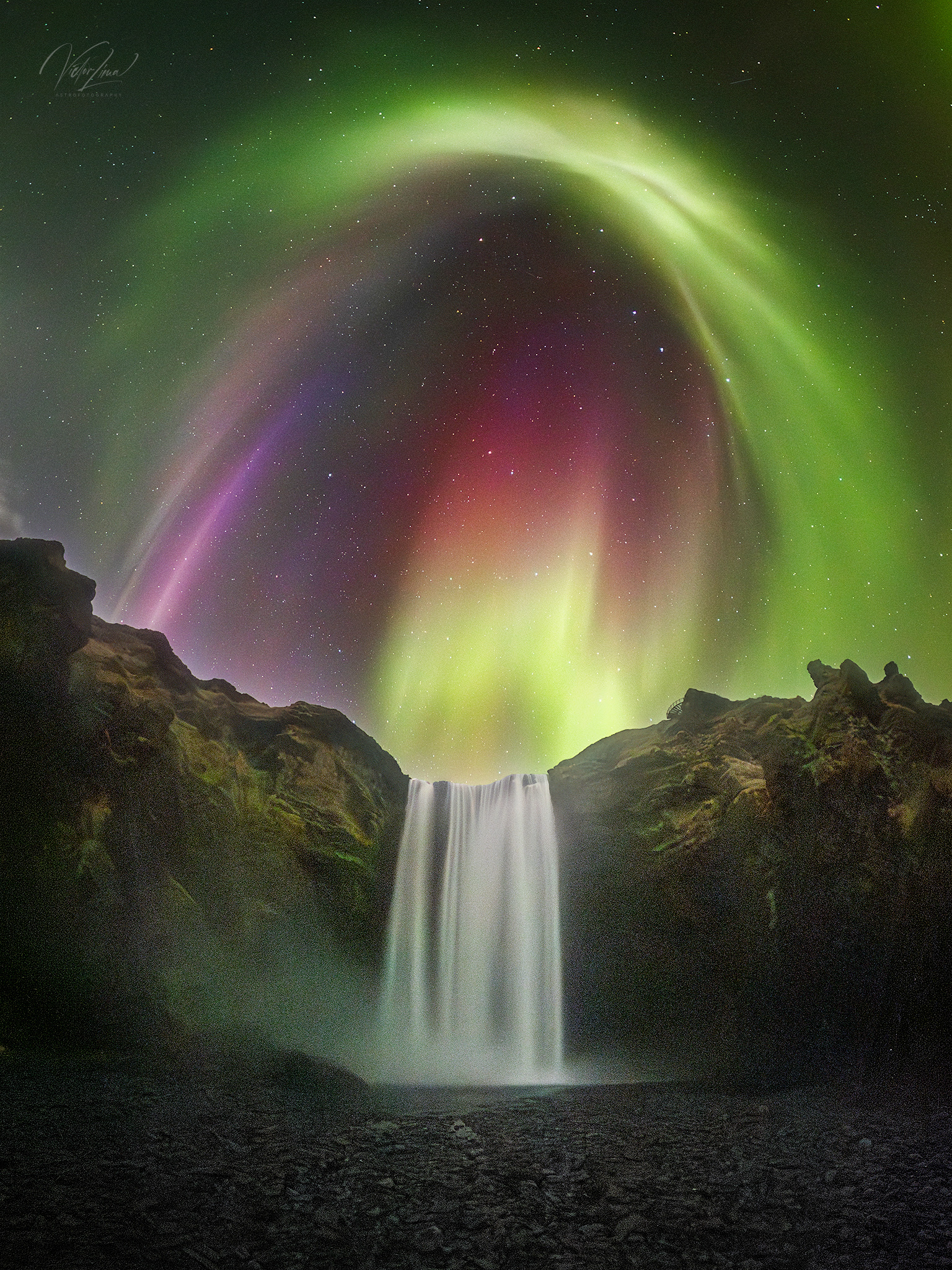
Image: NASA Open Science Data Network. A stunning aurora display over Skógafoss waterfall, Iceland, captured in April 2025 and highlighted by NASA in 2026.
The Science Behind the Spectacle: Solar Wind & Earth's Magnetic Dance
Auroras, often referred to as the northern (borealis) and southern (australis) lights, are a direct consequence of the Sun's activity. They are triggered
Disclaimer: Published for informational awareness & business consultation by Royal Bulls Advisory Private Limited (Pvt Ltd Co). Financial products (Loans, Mutual Funds, Insurance) are facilitated through authorized partner providers. Not a SEBI-registered Investment Advisor/RA; content is not certified stock market tips.


No comments:
Post a Comment