ROYAL BULLS ADVISORY
NASA's WB-57F Aircraft 'Chases the Moon's Shadow' Off Iceland: 2026 Solar Eclipse Mission Unveils Solar Corona Secrets & Planetary Insights from 50,000 Feet
A high-altitude scientific pursuit above the clouds delivers unparalleled views of the solar corona and celestial alignments during a rare total solar eclipse.
REYKJAVIK — September 5, 2026
Executive Summary
In a remarkable feat of aerial astronomy, NASA's WB-57F high-altitude research aircraft successfully intercepted the Moon's shadow during a total solar eclipse on August 12, 2026, off the coast of Iceland. Flying at an extraordinary 50,000 feet, the mission provided scientists with an unprecedented view of the solar corona and surrounding celestial bodies, circumventing atmospheric interference that typically hinders ground-based observations. The data collected by a suite of high-resolution cameras promises to unlock new secrets about our Sun's outer atmosphere and the intricate dance of our solar system.
Verified Key Takeaways
- NASA's WB-57F high-altitude research aircraft successfully observed a total solar eclipse on August 12, 2026, off the coast of Iceland.
- Operating at 50,000 feet, the aircraft flew along the precisely determined path of totality, maximizing observation time within the Moon's shadow.
- High-resolution cameras recorded crucial eclipse data, bypassing atmospheric interference common at ground level, such as clouds, dust, and water vapor.
- The mission provided an unparalleled view of the solar corona emerging during totality, offering critical insights for solar physics research.
- Celestial bodies including Venus, Jupiter, and Mercury were distinctly visible and captured in high-definition during the eclipse.
- Data collected will significantly enhance humanity's understanding of the Sun's dynamic outer atmosphere and its profound impact on space weather.
The Stratospheric Advantage: Above the Clouds, Beyond the Veil
The quest to understand our Sun often pushes the boundaries of observational science. On August 12, 2026, NASA embarked on a mission that epitomized this pursuit: "Chasing the Moon's Shadow." Utilizing its specialized WB-57F high-altitude research aircraft, the agency positioned its instruments directly within the path of totality during a total solar eclipse off the Icelandic coast. At an astounding altitude of 50,000 feet (approximately 15.2 kilometers), the aircraft soared above the vast majority of Earth's atmosphere, providing a pristine, unhindered view.
This stratospheric vantage point offered a crucial advantage over ground-based observations. By operating above clouds, dust, and atmospheric water vapor, the WB-57F's high-resolution cameras could capture data with unparalleled clarity, free from the distortions and scattering effects that typically plague terrestrial telescopes. The precision piloting ensured the aircraft remained within the Moon's shadow for the maximum possible duration, extending the precious moments of totality for scientific scrutiny.
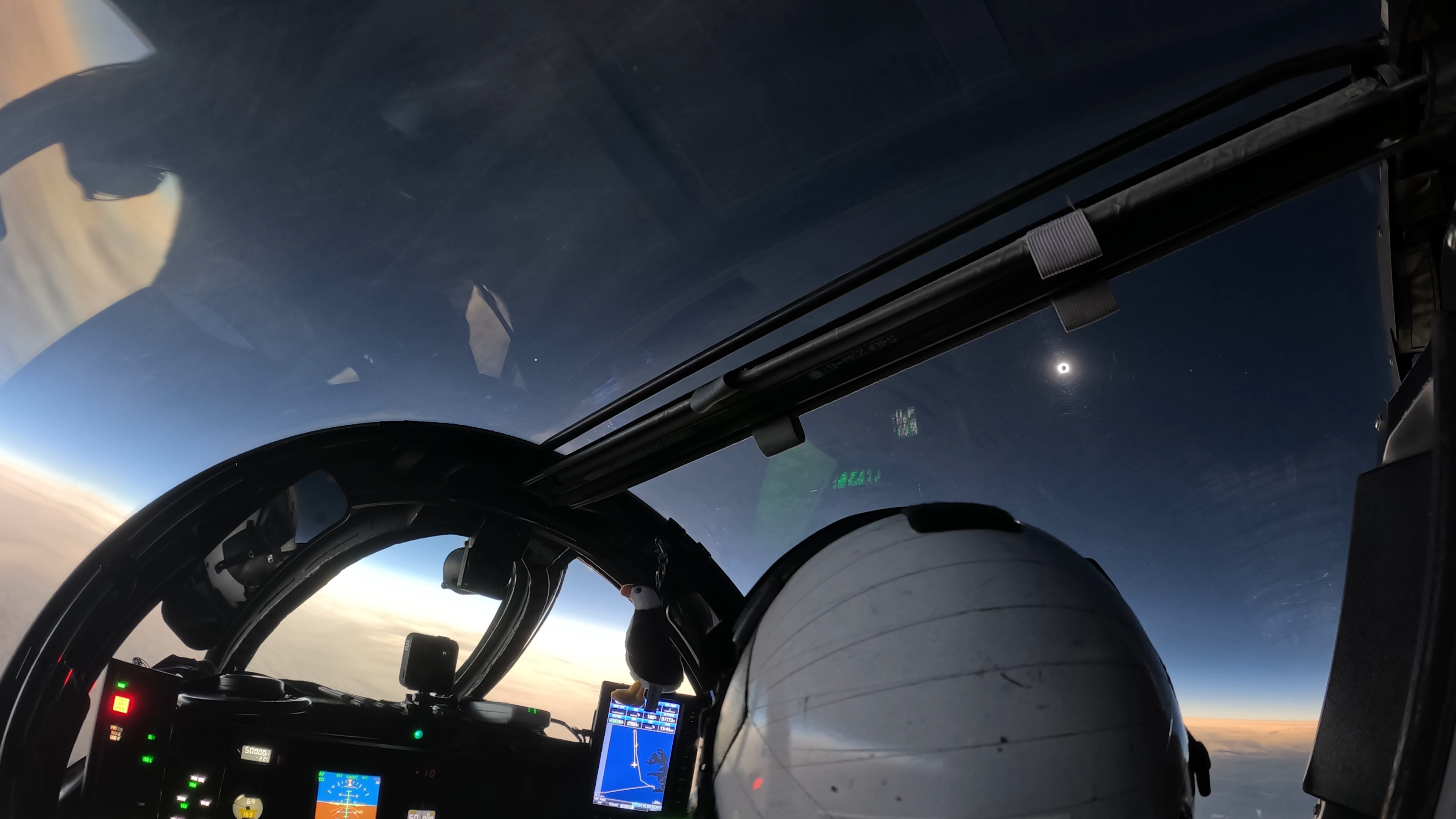
An incredible view from the cockpit of NASA's WB-57F aircraft, capturing the solar corona during totality on August 12, 2026, off the coast of Iceland. Venus, Jupiter, and Mercury are also visible. Credit: NASA Open Science Data Network.
Unveiling the Sun's Crown: Secrets of the Solar Corona
The primary target of the mission was the solar corona, the Sun's ethereal outer atmosphere, which is millions of degrees hotter than the surface and extends millions of kilometers into space. Ordinarily, the corona is completely obscured by the Sun's intense brightness. Only during a total solar eclipse, when the Moon perfectly blocks the solar disk, does the corona become visible, appearing as a shimmering, pearly white halo.
The WB-57F's observations provided an exceptionally clear view of the corona's intricate structures, including its streamers and loops, which are shaped by the Sun's powerful magnetic fields. Studying these features is vital for understanding fundamental processes like coronal heating, the origin of the solar wind, and the mechanisms behind solar flares and coronal mass ejections (CMEs) – phenomena that can significantly impact Earth's technology and space environment.
A Celestial Spectacle: Planets in the Eclipse's Embrace
Beyond the breathtaking view of the solar corona, the mission also captured a rare alignment of celestial bodies. As the sky darkened dramatically within the Moon's shadow, planets that are usually hidden by daylight became strikingly apparent. The inflight video footage from the cockpit distinctly showed Venus shining brightly to the left of the eclipsed Sun, while Jupiter and Mercury were just visible to
Disclaimer: Published for informational awareness & business consultation by Royal Bulls Advisory Private Limited (Pvt Ltd Co). Financial products (Loans, Mutual Funds, Insurance) are facilitated through authorized partner providers. Not a SEBI-registered Investment Advisor/RA; content is not certified stock market tips.


No comments:
Post a Comment